Posts

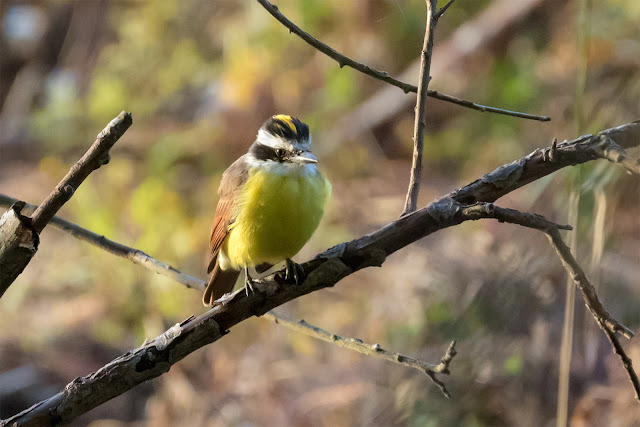
Great kiskadee.

Image
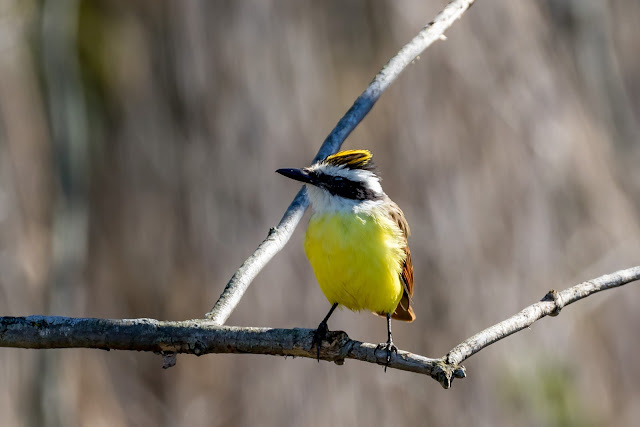
Great Kiskadee, Rondeau Provincial Park, Nov 2 2018. As long as it keeps showing up I will keep posting its photo. Such a rare bird and to have it around for this long is a real treat. It is finding enough to eat, frogs are still out and there are lots of berries for it. Pitangus sulphuratus Food - Great Kiskadees eat both animal prey and fruit. They hunt like a flycatcher, fish like a kingfisher, and forage like a jay. They perch on treetops in open areas, sallying forth to snatch flying insects in midair. They also glean through grass, shrubs, and trees for beetles, grasshoppers, spiders, millipedes, lizards, snakes, and small mice. Near bodies of water, they drop from perches to hover above the water’s surface and pluck prey such as small fish and tadpoles. They also eat fruit from trees, vines, cacti, and sometimes handouts from people. And they’ll boldly steal food from cat and dog dishes. source - https://www.allaboutbirds.org/guide/Great...
Image
Dark eyed junco with seed, Rondeau Provincial Park April 2017. They are already back this year. Rainy, miserable November day, over an inch so far, time to go through older photos. Junco hyemalis The Dark-eyed Junco is one of the most common birds in North America and can be found across the continent, from Alaska to Mexico, from California to New York. A recent estimate set the junco’s total population at approximately 630 million individuals. source - https://www.allaboutbirds.org/guide/Dark-eyed_Junco/

Red-breasted nuthatch.

Image
Red-breasted nuthatch, Oct 11, 2018, Rondeau Provincial Park. Up in a spruce tree. Sitta canadensis Red-breasted Nuthatches migrate southward earlier than many irruptive species. They may begin in early July and may reach their southernmost point by September or October. source -  https://www.allaboutbirds.org/guide/Red-breasted_Nuthatch

Greater yellowlegs.

Image
Greater yellowlegs - yes it does have legs under there. Rondeau Provincial Park, Ontario, Canada. Last boat ride of the year, decided to take it out before it snowed. Not a big selection however we did see several shorebirds, eagles and ducks. Sandhill cranes were a bonus. Tringa melanoleuca Colloquial names for this species include telltale, tattler, and yelper, all of which refer to its strident alarm calls.

Ruby in the grapes.

Image
Ruby-crowned kinglet in the grape vines, Oct 29, 2018, Rondeau Provincial Park, Ontario, Canada. Didn't look like it was interested in the grapes but it did like the little bugs attracted to the grape crop. Regulus calendula Metabolic studies on Ruby-crowned Kinglets suggest that these tiny birds use only about 10 calories (technically, kilocalories) per day. source -  https://www.allaboutbirds.org/guide/Ruby-crowned_Kinglet

Hudsonian godwit.

Image
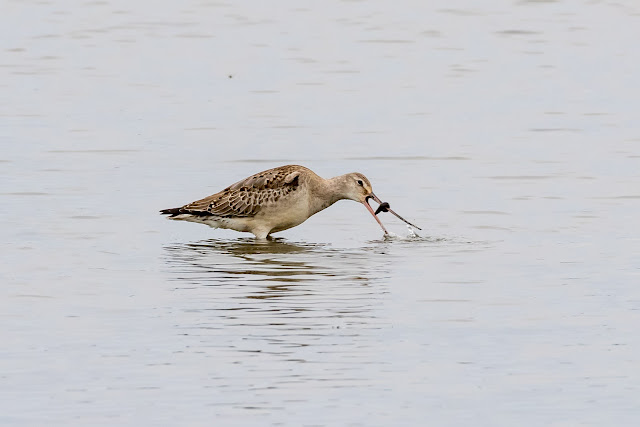
Hudsonian Godwit, Oct 25,2018, Keith McLean Conservation Area, near Rondeau Provincial Park, Ontario, Canada. Not as close as I would have liked but it will do. I like the way the leach is wrapped around the bill. Limosa haemastica After breeding, the Hudsonian Godwit undertakes a migration from the subarctic to southern South America, in which it apparently makes nonstop flights of several thousand miles. source - https://www.allaboutbirds.org/gui…/Hudsonian_Godwit/overview

Cooper's hawk.

Image
While looking for the Hudsonian godwit, which i saw, I came upon this Cooper's hawk standing on the path. it ignored me while it check out the grass along the edge, several times it ran along the path. Perhaps it was trying to flush our a small bird. Accipiter cooperii A Cooper's Hawk captures a bird with its feet and kills it by repeated squeezing. Falcons tend to kill their prey by biting it, but Cooper’s Hawks hold their catch away from the body until it dies. They’ve even been known to drown their prey, holding a bird underwater until it stopped moving. source - https://www.allaboutbirds.org/guide/Coopers_Hawk

Great kiskadee

Image
Two months to Christmas and the great kiskadee is still showing at Rondeau Provincial Park, Oct 24, 2018 We will have to make a tiny parka for it.

Great kiskadee.

Image
Two months to Christmas and the great kiskadee is still showing at Rondeau Provincial Park, Ontario, Canada, Oct 24, 2018 We will have to make a tiny parka for it.

Hermit thrush.

Image
Hermit thrush in the grapevines. Rondeau Provincial Park, Oct 21. 2018 Perhaps he is a vintner checking his crop. Catharus guttatus Hermit Thrushes sometimes forage by “foot quivering,” where they shake bits of grass with their feet to get insects. They also typically begin to quiver their feet as they relax after seeing a flying predator. Some scientists think the quivering happens as the bird responds to conflicting impulses to resume foraging or continue taking cover. source -  https://www.allaboutbirds.org/guide/Hermit_Thrush/

Lunch time.

Image
Eastern Phoebe with lunch, Rondeau Provincial Park, Ontario, Canada, Oct 22, 2018. While looking for the kiskadee, seen, spotted this phoebe with its catch. Reminded me of the bee eaters in Europe. Sayornis phoebe In 1804, the Eastern Phoebe became the first banded bird in North America. John James Audubon attached silvered thread to an Eastern Phoebe's leg to track its return in successive years. source - https://www.allaboutbirds.org/guide/Eastern_Phoebe

Baby storage

Image
Nine month storage limit.

Ruby-crowned kinglet.

Image
Ruby-crowned kinglet, Rondeau Provincial Park, Ontario, Canada, Oct 21, 2018. Lot of people looking for the great kiskadee in the park today. Many were successful in finding it, but there were lots of other birds around. This ruby-crowned kinglet was flitting through a grape vine looking for something to eat. Of course he wasn't showing the ruby crown. Regulus calendula The Ruby-crowned Kinglet is a tiny bird that lays a very large clutch of eggs—there can be up to 12 in a single nest. Although the eggs themselves weigh only about a fiftieth of an ounce, an entire clutch can weigh as much as the female herself. source - https://www.allaboutbirds.org/guide/Ruby-crowned_Kinglet

Field sparrow.

Image
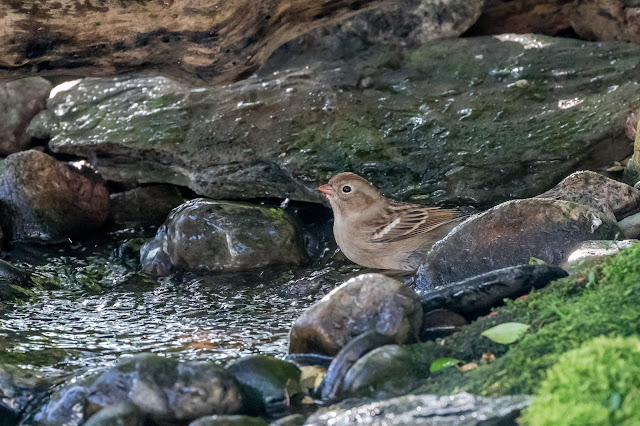
Field sparrow, Rondeau Provincial Park, Oct 15, 2018. Not as colourful as some of the birds that come to the pond but still a nice sight. Spizella pusilla Field Sparrows often breed more than once a season. They build a new nest each time, building them higher and higher off the ground as the season progresses. Early spring nests are often on the ground, where they’re less visible. As leaves and groundcover grow the birds build their nests in bushes and trees, where they’re safer from snakes and other predators. source - https://www.allaboutbirds.org/guide/Field_Sparrow/

Hello again.

Image
Greater kiskadee at Rondeau Provincial Park, Oct 18, 2018. After disappearing for weeks the kiskadee was found again today. Active and in the open, it put on a show. Pitangus sulphuratus The Great Kiskadee (so named for its three-syllable call) is one of the largest and most boisterous members of the tyrant flycatcher family. It has a big square head and stocky body like a kingfisher, and an omnivorous diet and bold behaviour like a jay. They often eat small fish and snails. source -  https://www.allaboutbirds.org/guide/Great_Kiskadee/

Nelson's sparrow.

Image
Nelson's sparrow, near Rondeau Provincial Park, Ontario, Canada, Oct 17, 2018. Nelson's sparrows have been in the area recently. 10-20 are being seen most days. Fast little skulkers, however, this one messed up and sat in the open for a minute. Ammospiza nelsoni A secretive sparrow with a brightly coloured face, the Nelson's Sparrow breeds along the edges of freshwater marshes and in wet meadows of interior North America, and in salt marshes along the northern Atlantic Coast. source - https://www.allaboutbirds.org/guide/Nelsons_Sparrow

Wood ducks.

Image
Wood ducks, Rondeau Provincial Park, Oct 14, 2018. Spotted two wood ducks lurking the the shadows along the shore while out on the pontoon. Not sure if these are non breeding plumage or first year birds, definitely not breeding colours. Aix sponsa Wood Ducks pair up in January, and most birds arriving at the breeding grounds in the spring are already paired. The Wood Duck is the only North American duck that regularly produces two broods in one year. source -  https://www.allaboutbirds.org/guide/Wood_Duck/

Harbours don't need to be fancy.

Image
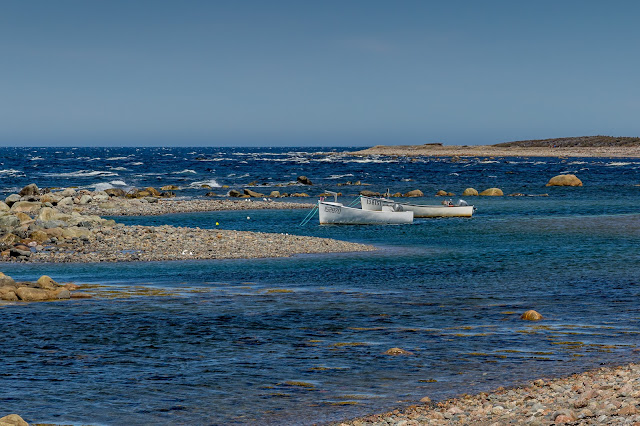
This is one of many small, make do, harbours we saw in Newfoundland. Small harbours, small boats against a big sea.

White-crowned sparrow.

Image
White crowned sparrow, Oct 7, 2018, Rondeau Provincial Park, Ontario, Canada. We still have a few white crowned and white throated sparrows coming to the pond. The white isn't as brilliant as it is in the spring, but it still stands out. Zonotrichia leucophrys A migrating White-crowned Sparrow was once tracked moving 300 miles in a single night. Alaskan White-crowned Sparrows migrate about 2,600 miles to winter in Southern California. The oldest recorded White-crowned Sparrow lived in California and was at least 13 years, 4 months old. source - https://www.allaboutbirds.org/guide/White-crowned_Sparrow/
Image
Greater yellow legs and lesser yellowlegs, Rondeau Provincial Park, Ontario, Canada, Oct 9, 2018. We had a group of 9 greater yellowlegs and a second flock of 3 greater and 4 lesser yellowlegs while out on the pontoon. Tringa melanoleuca - greater yellowlegs. Colloquial names for this species include telltale, tattler, and yelper, all of which refer to its strident alarm calls. Tringa flavipes - lesser yellowlegs. Both the male and female Lesser Yellowlegs provide parental care to the young, but the female tends to leave the breeding area before the chicks can fly, thus leaving the male to defend the young until fledging.