Posts

Showing posts with the label black-crowned night heron

Black-crowned night heron.

Image
Juvenile black-crowned night heron, Rondeau Provincial Park, Ontario, Canada, Sept 17, 2018. From the pontoon boat. Not overly concerned about us as we drifted by. Nycticorax nycticorax A breeding Black-crowned Night-Heron will brood any chick that is placed in its nest. The herons apparently don’t distinguish between their own offspring and nestlings from other parents. source -  https://www.allaboutbirds.org/…/Black-crowned_Nigh…/overview
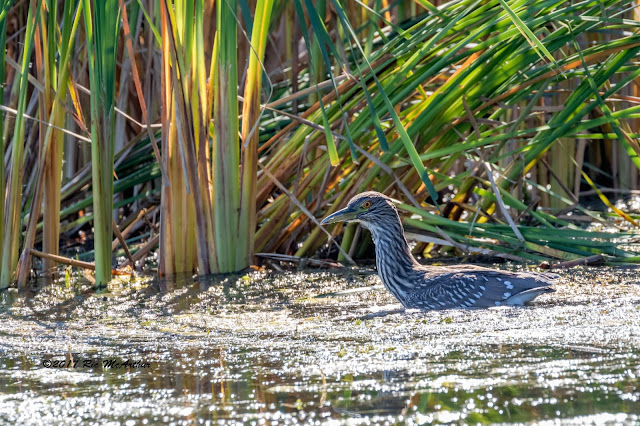
Black-crowned night heron

Image
Hip Deep. An immature black crowned night heron up to its belly at the edge of the marsh. It watched us for a while and then disappeared into the reeds. Nycticorax nycticorax A breeding Black-crowned Night-Heron will brood any chick that is placed in its nest. The herons apparently don’t distinguish between their own offspring and nestlings from other parents. source -  https://www.allaboutbirds.org/…/Black-crowned_N…/lifehistory

Pop up.

Image
While out on the pontoon we came across three immature black crowned night herons. I got some excellent, in the open shots but this one struck me as having the most character. Nycticorax nycticorax  Young Black-crowned Night-Herons leave the nest at the age of 1 month but cannot fly until they are 6 weeks old. They move through the vegetation on foot, joining up in foraging flocks at night.

Attack

Image
Attack , a photo by ricmcarthur on Flickr. We were in Ohio attending the Midwest Birding Symposium put on by Bird Watchers Digest this past weekend. On our way back we drove through a marsh area and saw a black-crowned night heron hunting. I had several photos of it staring at the water and then it took off after its prey, a small fish, which it caught and ate. My imac is not cooperating so I am having trouble retrieving photos. Scientific stuff Nycticorax nycticorax With a range that spans five continents, including much of North America, the Black-crowned Night-Heron is the most widespread heron in the world. It is most active at dusk and at night, feeding in the same areas that other heron species frequent during the day. Adult Description Medium-sized, stocky heron Short neck and thick black bill. Black cap and back. Wings gray. Underparts white. Source - Cornell Lab of Ornithology.