Posts

Showing posts with the label blackburnian warbler

Blackburnian warbler

Image
 Fall migration is under way. This Blackburnian warbler is one of the species we have seen over the last few days. Rondeau Provincial Park, Ontario, Canada, August 21, 2025. Setophaga fusca Tiny Blackburnian Warblers are strong fliers that travel between North and South America twice each year, so perhaps it isn’t surprising that they’re occasionally found very far off course. At times, “vagrants” have been recorded in Greenland, Iceland, Scotland, and the Azores off western Africa.

Blackburnian warbler

Image
  This beautiful warbler visited our pond today.  Nine species of warbler and a total of 50 species for the yard today . Rondeau Provincial Park, Ontario, Canada, May 23, 2025. Setophaga fusca Tiny Blackburnian Warblers are strong fliers that travel between North and South America twice each year, so perhaps it isn’t surprising that they’re occasionally found very far off course. At times, “vagrants” have been recorded in Greenland, Iceland, Scotland, and the Azores off western Africa.
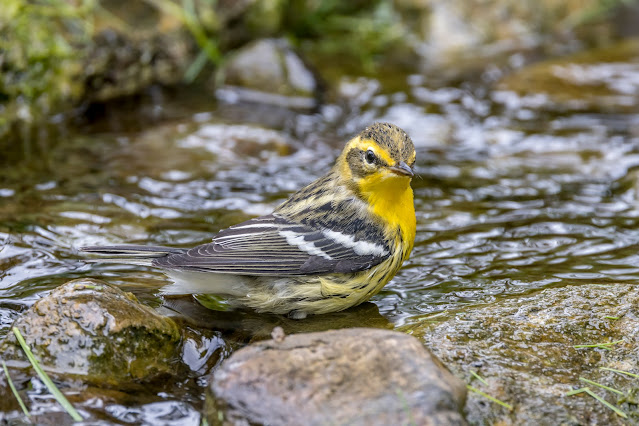
Blackburnian warbler.

Image
It's time for those confusing fall warblers. This is a Blackburnian warbler seen in our yard at Rondeau Provincial Park, Ontario, Canada, August 8, 2024. Setophaga fusca.  No other North American warbler has an orange throat.

Blackburnian warbler,

Image
Blackburnian warbler, Rondeau Provincial Park, August 5, 2023. Another fall migrant in the yard Setophaga fusca In springtime, rival male Blackburnian Warblers perform remarkable territorial conflicts that recall an aerial ballet. They chase one another through and around the treetops, flying in loops, plummeting downward through the branches in a whirling pattern, gliding with tail raised and spread, or slowly flapping in exaggerated “moth flight,” as researchers call it. Once territories are established, the aerobatics die down. source -Cornell Lab of Ornithology

And they keep on coming!

Image
Eleven species of warblers at the hedge and water feature. It's like a box of chocolates - you never know what you're going to get. This time it is a pair of Blackburnians and a Tennessee. Who knows what the next group will be. If you don't have room or the patience for a recirculating pond check out WarblerFall, from Julie Zickefoose. www.warblerfall.com She is good people and gives great advice, you can't go wrong. Rondeau Provincial Park, Aug 19, 2022.

Fire throat.

Image
Blackburnian warbler, Rondeau Provincial Park, Ontario, Canada, Sept 24, 2021. A fairly rgular visitor to the yard during the fall migration. During the spring they tend to be high in the canopy. Setophaga fusca No other North American warbler has an orange throat. Source - Cornell Lab of Ornithology.

Blackburnian warbler.

Image
Rondeau Provincial Park, Ontario, Canada, Aug 22, 2021. The fall warbler migratiion is under way with a number of species stopping in the yard. We also had Cape May, Bay breasted and yellow warblers. The hedge is full of insects and the water seems to be appreciated during this heat. Setophaga fusca Tiny Blackburnian Warblers are strong fliers that travel between North and South America twice each year, so perhaps it isn’t surprising that they’re occasionally found very far off course. At times, “vagrants” have been recorded in Greenland, Iceland, Scotland, and the Azores off western Africa.

Blackburnian Warbler

Image
Rondeau Provincial Park, Ontario, Canada, May 14, 2019. One of the many colourful spring migrants that come through the park. Setophaga fusca Tiny Blackburnian Warblers are strong fliers that travel between North and South America twice each year, so perhaps it isn’t surprising that they’re occasionally found very far off course. At times, “vagrants” have been recorded in Greenland, Iceland, Scotland, and the Azores off western Africa. source - https://www.allaboutbirds.org/guide/Blackburnian_Warbler/

Blackburnian warbler

Image
May 10, 2018, Rondeau Provincial Park, Ontario, Canada. Setophaga fusca In springtime, rival male Blackburnian Warblers perform remarkable territorial conflicts that recall an aerial ballet. They chase one another through and around the treetops, flying in loops, plummeting downward through the branches in a whirling pattern, gliding with tail raised and spread, or slowly flapping in exaggerated “moth flight,” as researchers call it. Once territories are established, the aerobatics die down. source - Cornell Lab of Ornithology.
Image
Blackburnian warbler, Rondeau Provincial Park, May 18, 2019. Posing nicely on Tulip Tree Trail. Setophaga fusca Tiny Blackburnian Warblers are strong fliers that travel between North and South America twice each year, so perhaps it isn’t surprising that they’re occasionally found very far off course. At times, “vagrants” have been recorded in Greenland, Iceland, Scotland, and the Azores off western Africa. source -  https://www.allaboutbirds.org/guide/Blackburnian_Warbler

Blackburnian Warbler.

Image
Heavy rains all day so I spent some time going through photos I took over the past week. Here is a Blackburnian warbler at Rondeau Provincial Park. Setophaga fusca No other North American warbler has an orange throat. Although the Blackburnian Warbler does not associate with other birds while it is nesting, it will join foraging flocks of chickadees, kinglets, and nuthatches after the young fledge. The warbler will follow the mixed flock with its begging young. The begging of the warbler chicks can even attract chickadees. source -  https://www.allaboutbirds.org/guide/Blackburnian_Warbler/

Fall migration is underway.

Image
We have started seeing warblers on their way south. Cape May, Black and White,Redstarts and Blackburnian among others. This is an immature/ 1st winter bird at our pond. Setophaga fusca No other North American warbler has an orange throat.

Fire throat

Image
This blackburnian warbler was stretching for a bug this morning at Rondeau Provincial Park. Despite being Friday the 13th we had a great day birding, we saw 25 warbler species and heard one more. Setophaga fusca No other North American warbler has an orange throat. source - Cornell Lab of Ornithology.

Blackburnian warbler.

Image
Not the best photo I've taken of this warbler species but a really nice surprise while walking a trail. Five species of warblers have warblers have been seen in the last few days along with other spring migrants. Setophaga fusca No other North American warbler has an orange throat The Blackburnian Warbler is territorial on its breeding grounds and solitary in the winter. It forms flocks only during migration. source Cornell Lab of Ornithology.