Posts

Showing posts with the label Dumetella carolinensis

Grey catbird

Image
Having an explosive bath at the water feature in the yard. Rondeau Provincial Park, Ontario, Canada, June 1, 2025. I like the way the water  looks like an exploding firework. Dumetella carolinensis The Gray Catbird belongs to the genus  Dumetella , which means “small thicket.” And that’s exactly where you should go look for this little skulker.

Gray catbird, close-up

Image
 A pond visitor today, Rondeau Provincial Park, Ontario, Canada, May 31, 2024. Dumetella carolinensis The Gray Catbird belongs to the genus  Dumetella , which means “small thicket.” And that’s exactly where you should go look for this little skulker.

Gray catbird

Image
Gray catbird with lunch, Rondeau Provincial Park, July 16, 2023. I was able to capture images of several bird species with food in their beaks. This one was my favourite of the day. Dumetella carolinensis. The oldest known Gray Catbird was at least 17 years, 11 months old when it was recaptured and rereleased during banding operations in New Jersey in 2001. It had been banded in Maryland in 1984.. source -Cornell Lab of Ornithology

Washing lunch.

Image
Grey catbird having a bath while holding onto its meal. Rondeau Provincial Park, June 15, 2023. Dumetella carolinensis. T he Gray Catbird belongs to the genus Dumetella, which means “small thicket.” And that’s exactly where you should go look for this little skulker. source -Cornell Lab of Ornithology

Do these feathers make me look fat?

Image
Gray catbird at the water, Rondeau Provincial Park, June 5, 2023. An enthusiastic bather. Dumetella carolinensis. The Gray Catbird’s long song may last for up to 10 minutes.

Grey catbird.

Image
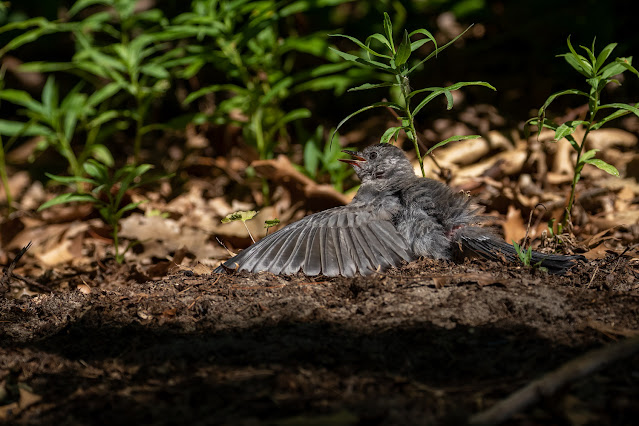
Not sure if it was having a dust bath or if it was anting. Anting is a maintenance behavior during which birds rub insects, usually ants, on their feathers and skin. The bird may pick up the insects in its bill and rub them on the body (active anting), or the bird may lie in an area of high density of the insects and perform dust bathing-like movements (passive anting). The insects secrete liquids containing chemicals such as formic acid, which can act as an insecticide, miticide, fungicide, or bactericide. Alternatively, anting could make the insects edible by removing the distasteful acid, or, possibly supplement the bird's own preen oil. Instead of ants, birds can also use millipedes. More than 200 species of bird are known to ant. Dumetella carolinensis Rondeau Provincial Park, July 24, 2022.

Gray catbird.

Image
Gray catbird frolicking in the water. Rondeau Provincial Park, July 23, 2022. Another of the birds that take enthusiastic baths. Dumetella carolinensis The Gray Catbird’s long song may last for up to 10 minutes. source - Cornell Lab of Ornithology. 

Bath time.

Image
Grey catbird, Rondeau Provincial Park, July 10, 2022. With the dry weather we are getting more birds in for a bath. Robins try to empty the water feature but the catbird is slightly less enthusiastic in its splashing. Dumetella carolinensis The Gray Catbird belongs to the genus Dumetella, which means “small thicket.” And that’s exactly where you should go look for this little skulker. source - Cornell Lab of Ornithology.

Grey catbird

Image
Rondeau provincial Park, Ontario, Canada, May 5 2022. Typical activity, tossing leaves and skulking in the underbrush. Dumetella carolinensis The Gray Catbird’s long song may last for up to 10 minutes. source - Cornelll Lab of Ornithology.

Dance like nobody is watching.

Image
Catbird, Rondeau Provincial Park, Ontario, Canada, July 3, 2021. Flitted around the pond as if it could hear a tune. Dumetella carolinensis

Grey catbird,

Image
Rondeau Provincial Park, Ontario, Canada, July 4, 2021. More often heard than seen around our yard. The Gray Catbird belongs to the genus Dumetella, which means “small thicket.” And that’s exactly where you should go look for this little skulker. Dumetella carolinensis The oldest known Gray Catbird was at least 17 years, 11 months old when it was recaptured and rereleased during banding operations in New Jersey in 2001. It had been banded in Maryland in 1984.

Grey catbird

Image
July 12, 2020, Rondeau Provincial Park, Onntario, Canada. Most often skulking in the underbrush bur they come out for the water in the yard. Dumetella carolinensis The Gray Catbird’s long song may last for up to 10 minutes. The oldest known Gray Catbird was at least 17 years, 11 months old when it was recaptured and rereleased during banding operations in New Jersey in 2001. It had been banded in Maryland in 1984. source - https://www.allaboutbirds.org/guide/Gray_Catbird/

Gray catbird.

Image
Gray catbird, June 17, 2019, Rondeau Provincial Park, Ontario, Canada. Dumetella carolinensis The Gray Catbird’s long song may last for up to 10 minutes.

Elegant.

Image
Gray catbird, Rondeau Provincial Park, Ontario, Canada, June 17, 2019 I think of these birds as being elegant, all dressed up for a party. Dumetella carolinensis The Gray Catbird’s long song may last for up to 10 minutes. The oldest known Gray Catbird was at least 17 years, 11 months.

The jelly thief.

Image
We put out grape jelly for the orioles and it turns out that gray catbirds like it as well. Not big enough to push orioles off, he just waits his turn. How Canadian. Dumetella carolinensis The Gray Catbird’s long song may last for up to 10 minutes. source - https://www.allaboutbirds.org/guide/Gray_Catbird/lifehistory

Catbird in the pond.

Image
We have several nesting pairs in the immediate area of our yard. They regularly come in to eat the grapes and grape jelly that we put out for the orioles. Dumetella carolinensis The Gray Catbird belongs to the genus Dumetella, which means “small thicket.” And that’s exactly where you should go look for this little skulker. source - Cornell Lab of Ornithology

The cats meow.

Image
This gray catbird was in the cat bird's seat at the top of the feeder. The cat's meow is an old expression, before my time, meaning  - An individual who is just really cool! Very likable and suave. Dumetella carolinensis The Gray Catbird’s long song may last for up to 10 minutes. The oldest known Gray Catbird lived to be 17 years 11 months old. source - Cornell Lab of Ornithology.