Posts

Showing posts with the label Plestiodon fasciatus

Five-lined skink.

Image
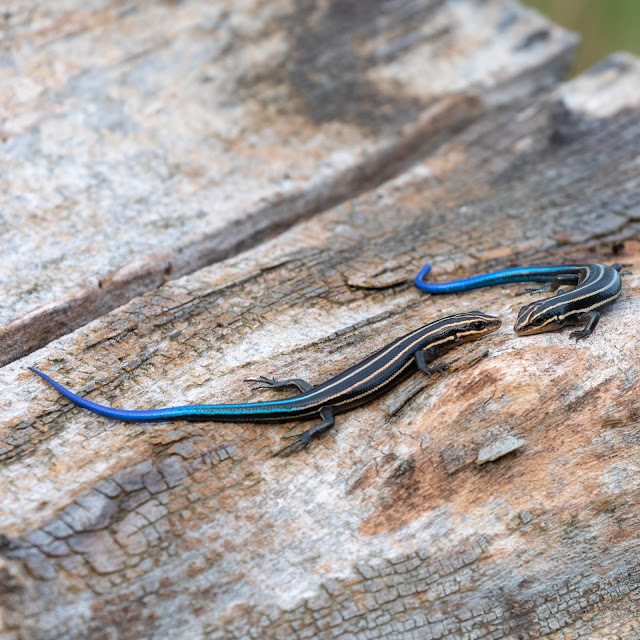
Spotted the five-lined skink on a log near our water feature. Rondeau Provincial Park, Ontario, Canada, August 16, 2025. Common five-lined skink   is a small (up to 8.6 cm ) black or grey coloured lizard. Juveniles have five cream-coloured stripes along their back and a blue tail. It is the only   lizard native to Ontario. Found in a small area of southwestern Ontario near the shorelines of Lake Erie, St. Clair, and Huron. This population is considered endangered due to habitat loss and other threats. Plestiodon  fasciatus 

Five-lined skink

Image
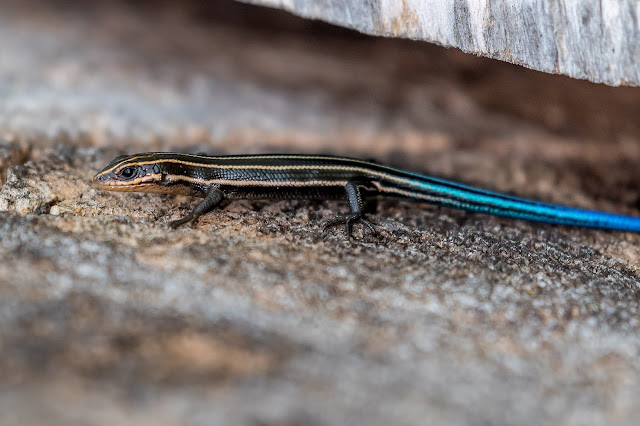
Male five lined skink during molt. Rondeau provincial Park, May 21, 2023. Saw this skink, which is shedding its skin like a snake does. The colour on its face was unusual and ,Anne did the photo colour is correct - I'm red/green colour blind. Plestiodon fasciatus Common Five-lined Skink is a small (up to 8.6 cm) black or grey coloured lizard. Juveniles have five cream-coloured stripes along their back and a blue tail. The stripes and blue tail fade with age. During the breeding season, males have orange colouration around the jaws and chin. Common Five-lined Skink feeds on insects, worms and other invertebrates. They are very agile hunters.

More from the archives.

Image
Five lined skinks, Rondeau Provincial Park, Ontario, Canada, Aug 27, 2019. Plestiodon fasciatus The five-lined skink is a smooth, slender lizard that can grow to 21 centimetres in length, but most individuals are much smaller. Their coloration varies with age. Juveniles and young adult females are glossy black with five cream stripes down the back and a bright blue or blue-grey tail. Males and older females gradually fade to a more uniform bronze, although often the stripes are still visible. Males in breeding condition have a bright orange chin and jaw.

Common Five lined skink

Image
Rondeau Provincial Park, Ontario, Canada, Aug 21, 2019. Anne found a log that has become skink habitat. We check it each day and there is a family of skinks using the habitat. There is a long deep fissure where they like to hide, I flipped this one from vertical to horizontal to make it easier to relate to. Plestiodon fasciatus

Common Five-lined Skink

Image
August 13, 2019, Rondeau Provincial Park, Ontario, Canada. Plestiodon fasciatus The Common Five-lined Skink is the only lizard native to Ontario. Juveniles and some adults have five stripes that run down the back. Juveniles have bright blue tails, but the colour fades with age. Females typically lay a clutch of 9-10 eggs under cover, such as logs or rocks. The young mature in just under two years and typically live less than five years.
Image
My little lizard We are fortunate to have five lined skinks around our yard. They have been hiding and this is the first one I have photographed this year. He was in a little burrow under a piece of wood. The head and tail are together with a foot near the bottom. Plestiodon fasciatus The five-lined skink is a smooth, slender lizard that can grow to 21 centimetres in length, but most individuals are much smaller. Their coloration varies with age. Juveniles and young adult females are glossy black with five cream stripes down the back and a bright blue or blue-grey tail. Males and older females gradually fade to a more uniform bronze, although often the stripes are still visible. Males in breeding condition have a bright orange chin and jaw. source - Ontario Nature.

The runner

Image
This five lined skink was running through the grass near the pond in our yard back in 2011. They are Ontario's only lizard. Plestiodon fasciatus The five-lined skink is a smooth, slender lizard that can grow to 21 centimetres in length, but most individuals are much smaller. Their coloration varies with age. Juveniles and young adult females are glossy black with five cream stripes down the back and a bright blue or blue-grey tail. Males and older females gradually fade to a more uniform bronze, although often the stripes are still visible. Males in breeding condition have a bright orange chin and jaw. source - Ontario Nature

Thereby hangs a tail.

Image
One of the researchers took me along to check on a slink nest today. The eggs are just about ready to hatch. When he rolled the log back the adult was wrapped around the eggs but slowly burrowed into the ground. Plestiodon fasciatus The five-lined skink is Ontario’s only native species of lizard.

I am not a snake!

Image
Take a closer look. I have legs. I am a five lined skink, and I am Ontario's only lizard. Plestiodon fasciatus The five-lined skink is a smooth, slender lizard that can grow to 21 centimetres in length, but most individuals are much smaller. If a predator catches a skink by the tail, it will break off and begin to thrash about. The moving tail distracts the predator while the lizard escapes. source - Ontario Nature.

The hatchlings

Image
The hatchlings , a photo by ricmcarthur on Flickr. The skink researcher came to the cottage today and we checked on the skink nest. At least three of the eggs had hatched, possibly more. The egg at the top appears to be just starting to hatch out. The scientific stuff - The five-lined Skink (Plestiodon fasciatus) is a small, smooth-bodied lizard, with black or grey colouring and five white or yellow stripes along the back. The colour pattern diminishes with age as the stripes darken, and the contrast is less apparent in adults. Juveniles have bright blue tails, but this also diminishes with age. In adults, the tail is grey. Adult males can be distinguished from females by their broader heads and bright orange jaws and chin. Adults can reach a length of 20 centimetres. Skinks are very active predators, and they dart quickly from place to place looking for insects, worms or other invertebrates. The southwestern populations of the five lined skink, are Endangered Provincially and Nati...

Five lined skink and eggs

Image
Five lined skink and eggs , a photo by ricmcarthur on Flickr. I came upon this nest on our cottage lot by accident the other day. Female skink and 8 eggs. I will check now and then to see if I can get a photo of a hatchling. So as not to disturbed the nest too much I am limited to once every two days. Plestiodon fasciatus

Ok, I caught him, now how do I eat him?

Image
Ok, I caught him, now how do I eat him? , a photo by ricmcarthur on Flickr. I had the opportunity yesterday of going out with one of the researchers working at Rondeau Provincial Park. He is doing work on 5 lined skinks and salamanders. He had just finished weighing and measuring this male skink when it bit him and wouldn't let go. It looked like this small animal had attacked and bitten prey that was way to big. Eventually it let go and went back underneath a log. Plestiodon fasciatus For more information on the skink you can follow this link www.rom.on.ca/ontario/risk.php?doc_type=fact&id=152

If I don't move you can't see me.

Image
If I don't move you can't see me. , a photo by ricmcarthur on Flickr. This five-lined skin was sunning on a fallen log as I walked by. It watched me closely but didn't move until I was about 10 feet away. Extremely fast, it was gone in the blink of an eye. It is the only species of lizard found in Ontario. (Plestiodon fasciatus) It is a small, smooth-bodied lizard, with black or grey colouring and five white or yellow stripes along the back. The colour pattern diminishes with age as the stripes darken, and the contrast is less apparent in adults. Juveniles have bright blue tails, but this also diminishes with age. In adults, the tail is grey. Adult males can be distinguished from females by their broader heads and bright orange jaws and chin. Adults can reach a length of 20 centimetres. Skinks are very active predators, and they dart quickly from place to place looking for insects, worms or other invertebrates. Source - ROM www.rom.on.ca/ontario/risk.php?doc_type=fact...