Posts

Showing posts with the label Podiceps auritus

I'm forever blowing bubbles.

Image
This horned grebe was in slow down mode after dashing across the water. Not sure if I like the bow wave or the bubbles more. Long Point Provincial Park, April 2, 2023. Podiceps auritus A sleeping or resting Horned Grebe puts its neck on its back with its head off to one side and facing forward. It keeps one foot tucked up under a wing and uses the other one to maneuver in the water. Having one foot up under a wing makes it float with one "high" side and one "low" side. source - allaboutbirds-org.

Horned grebes.

Image
Pair of horned grebes, just outside Rondeau Provincial Park, March 29, 2023. First time I have seen the male and female together. Usually I just see males. Podiceps auritus As in many grebe species, Horned Grebe frequently ride on their parents' backs, nestled in between their wings. The chicks may even go underwater with their parents during dives.

Lift off

Image
Horned grebe, Erieau, Ontario, Canada, April 27, 2019. Went looking for the eared grebe at Erieau, which I saw, got this photo off the horned grebe from the pontoon. The grebe was going left, I was going right and the boat was rocking. Podiceps auritus The oldest recorded Horned Grebe was at least 5 years, 11 months old when it was recaptured and rereleased during banding operations in the Northwest Territories in 2007, the same place where it had been banded in 2002. souce -  https://www.allaboutbirds.org/guide/Horned_Grebe

Grebe in a ditch

Image
On the way to look for the cinnamon teal - got it - we saw this horned grebe in a ditch beside the road. It appeared to have enough room to take off when it was ready. Near Hillman Marsh, Ontario, Canada. April 21, 2019. Podiceps auritus A sleeping or resting Horned Grebe puts its neck on its back with its head off to one side and facing forward. It keeps one foot tucked up under a wing and uses the other one to maneuver in the water. Having one foot up under a wing makes it float with one "high" side and one "low" side. source - https://www.allaboutbirds.org/guide/Horned_Grebe/

Horned grebe.

Image
What was that about a bad hair day? Welcome to my world. Horned grebe in a messy plumage. Podiceps auritus Like most grebes, the small chicks of the Horned Grebe frequently ride on the backs of their swimming parents. The young ride between the wings on the parent's back, and may even go underwater with them during dives. source - https://www.allaboutbirds.org/guide/Horned_Grebe/

Horned grebe.

Image
The ice at a local dock/restaurant finally broke up and grebes are using the basin again. Located just outside of Rondeau Provincial Park. Podiceps auritus A sleeping or resting Horned Grebe puts its neck on its back with its head off to one side and facing forward. It keeps one foot tucked up under a wing and uses the other one to maneuver in the water. Having one foot up under a wing makes it float with one "high" side and one "low" side. source - https://www.allaboutbirds.org/guide/Horned_Grebe/
Image
Two of more than 40 horned grebes we saw Oct 26 while boating on Rondeau Bay.. We tend to see them during spring and fall. Podiceps auritus A sleeping or resting Horned Grebe puts its neck on its back with its head off to one side and facing forward. It keeps one foot tucked up under a wing and uses the other one to maneuver in the water. Having one foot up under a wing makes it float with one "high" side and one "low" side. source -https://www.allaboutbirds.org/guide/Horned_Grebe/lifehistory

Catch of the day.

Image
Went to the shorebird cell at Hillman Marsh to see what was around. The closest birds were horned grebes. Several popped up with fish while we were there. Podiceps auritus Like most grebes, the small chicks of the Horned Grebe frequently ride on the backs of their swimming parents. The young ride between the wings on the parent's back, and may even go underwater with them during dives.

Horned grebe

Image
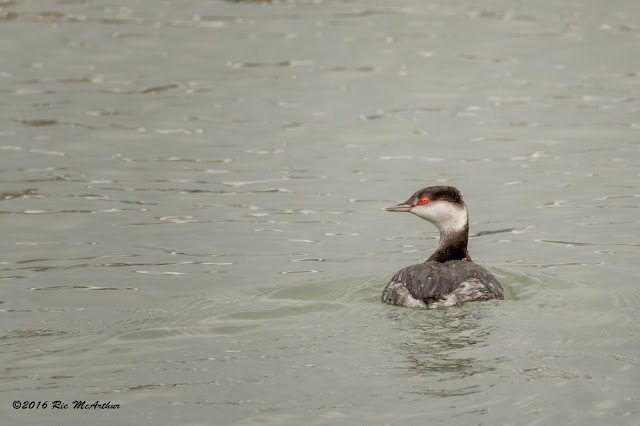
Horned Grebe, Rondeau Provincial Park, summer 2016. Podiceps auritus A sleeping or resting Horned Grebe puts its neck on its back with its head off to one side and facing forward. It keeps one foot tucked up under a wing and uses the other one to maneuver in the water. Having one foot up under a wing makes it float with one "high" side and one "low" side.

Horned grebe at Erieau.

Image
Horned grebe at Erieau. Podiceps auritus  Like most grebes, the small chicks of the Horned Grebe frequently ride on the backs of their swimming parents. The young ride between the wings on the parent's back, and may even go underwater with them during dives.

Sushi for lunch

Image
A large number of horned grebes are currently at Erieau, Ontario. I saw at least 11 at one time in various plumages. This one had just caught a small fish. Podiceps auritus Familiar to most North American birders in its black-and-white winter plumage, the Horned Grebe is more striking in its red-and-black breeding feathers. Its "horns" are yellowish patches of feathers behind its eyes that it can raise and lower at will. source - Cornell Lab of Ornithology

Low rider

Image
This horned grebe rides low in the water and can do a fast flip and disappear in the blink of an eye. There were four of them, in non-breeding plumage, cruising in the lake of Rondeau Provincial Park. Podiceps auritus A sleeping or resting Horned Grebe puts its neck on its back with its head off to one side and facing forward. It keeps one foot tucked up under a wing and uses the other one to maneuver in the water. Having one foot up under a wing makes it float with one "high" side and one "low" side.