Posts

Showing posts with the label wonderful wildlife window

Wonderful Wildlife Window.

Image
Northern cardinal, Rondeau Provincial Park, Ontario, Canada, March 4, 2019. This year we seem to have a lot of cardinals, up to a dozen at at time. Real pleasure to watch out the living room window. Cardinalis cardinalis Only a few female North American songbirds sing, but the female Northern Cardinal does, and often while sitting on the nest. This may give the male information about when to bring food to the nest. A mated pair shares song phrases, but the female may sing a longer and slightly more complex song than the male. source -   https://www.allaboutbirds.org/guide/Northern_Cardinal/

Fox sparrow

Image
We tend to get these birds passing through in the spring and for a short time in the fall. They are a large, heavily streaked sparrow. Taken through the living room window. Passerella iliaca Fox Sparrow fossils from the Pleistocene (about 11,000 years ago) have been found in Pennsylvania, Virginia, and at the La Brea tar pits in California.

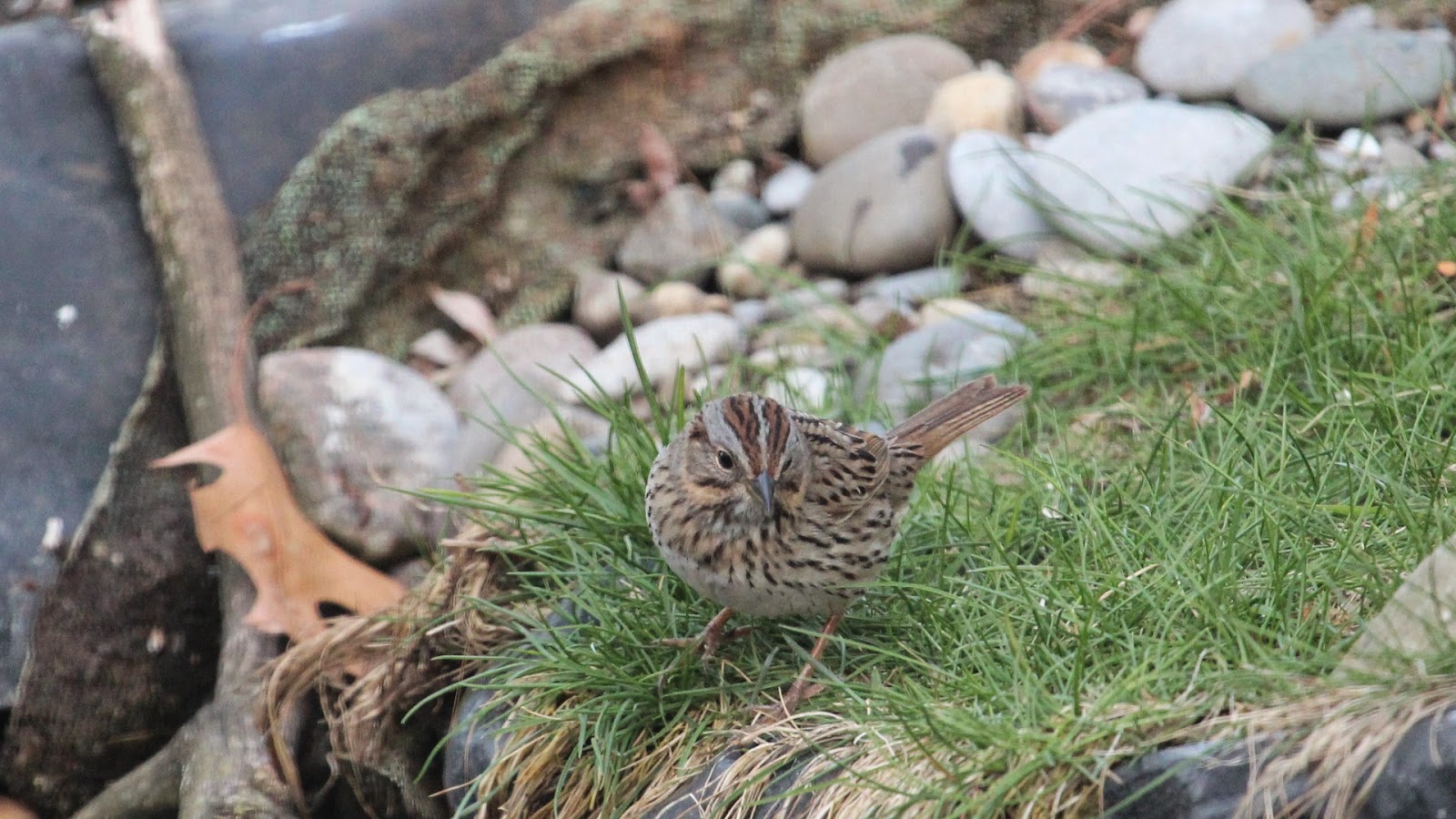
Lincoln's sparrow.

Image
Not a rare bird but one we don't see every year. This Lincoln's sparrow showed up at the pond this evening. Melospiza lincolnii The Lincoln's Sparrow shows less geographical variation in song than any other species in its genus, perhaps a result of high dispersal rates among juveniles.

He tends to stand out in a crowd.

Image
We had eleven northern cardinals in the yard yesterday. Cardinals are common around here and tend to be overlooked just like bluejays. Winter would be bland if it weren't for the cardinals and jays. Most of the other birds are dull during the winter. We don't get many during the warmer months, I guess there is enough food that they don't need what we put out. This winter has been hard on the wildlife. We have a turkey that comes to the yard regularly, 6 deer, many squirrels and several rabbits, not to mention raccoons. Cardinalis cardinalis Cardinals don't migrate and they don't molt into a dull plumage. The male cardinal fiercely defends its breeding territory from other males. When a male sees its reflection in glass surfaces, it frequently will spend hours fighting the imaginary intruder. The oldest recorded Northern Cardinal was 15 years 9 months old. source - Cornell Lab of ornithology

Double your pleasure,double your fun..

Image
Twice the destructive force. Recently our little pond has been torn up each morning. I assumed that it was a raccoon but it turns out I was wrong. It was two raccoons. Double trouble. They are young ones that came out during the day. Taken through the Wonderful Wildlife Window. Procyon lotor  (almost sounds like a character from a Batman movie) These ubiquitous mammals are found in forests, marshes, prairies, and even in cities. They are adaptable and use their dexterous front paws and long fingers to find and feast on a wide variety of fare.

A chilly bed.

Image
A chilly bed. , a photo by ricmcarthur on Flickr. It has been a hard winter for humans and wildlife this year. We don't normally see where the deer bed down for the night, usually it is back in the forest. We are seeing them close to the cottage and I am guessing they are waiting for us to put out bird seed. If they are first to the yard the get the seed, not other deer and certainly they don't leave much for the birds. This doe was bedded down early in the morning right after the last big storm. There heavy outer coat seems to keep them dry. Photo taken through the Wonderful Wildlife Window. Odocoileus virginianus Like a cow, the white-tailed deer’s stomach has four compartments. This allows food to be processed more efficiently and means that the deer can feed on things that other mammals cannot process.

Looking for a free lunch

Image
Looking for a free lunch , a photo by ricmcarthur on Flickr. This small opossum was scrounging under the bird feeders in search of a free lunch. The temperatures were above freezing today which probably encouraged him to come out. They are omnivores and they eat insects, snails, rodents, berries, fruit, grasses, leaves, carrion, snakes, bird and waterfowl eggs, corn and all other vegetables. This photo was taken through the Wonderful Wildlife Window. Scientific stuff Didelphis virginiana They are North America's only marsupial (female has a pouch) mammal. A female can bear up to 14 young and when they are born the entire litter can fit onto a teaspoon. Opossums are active year round and do not hibernate; however during extreme weather they may stay in dens for weeks at a time using up stored body fats.

Blue on blue

Image
Blue on blue , a photo by ricmcarthur on Flickr. I was surprised at how clear this photo was considering I took it through the Wonderful Wildlife Window which I haven't cleaned recently. We have a regular parade of birds into our feeders particularly in the winter. Scientific stuff Cyanocitta cristata The pigment in Blue Jay feathers is melanin, which is brown. The blue colour is caused by scattering light through modified cells on the surface of the feather barbs. The black bridle across the face, nape, and throat varies extensively and may help Blue Jays recognize one another. The oldest known wild, banded Blue Jay lived to be at least 17 years 6 months old. www.allaboutbirds.org/guide/blue_Jay/lifehistory

Taunting

Image
Taunting , a photo by ricmcarthur on Flickr. A chipmunk was sitting right outside the window taunting the boys. They ran from window to window following the little critter but, somehow, they could never catch it. You can just make out our small water feature in the upper right. It isn't large but it does bring in a lot of birds and an occasional chipmunk. This is the Wonderful Wildlife Window.