Posts

Showing posts with the label Melanerpes erythrocephalus

Red-headed woodpecker

Image
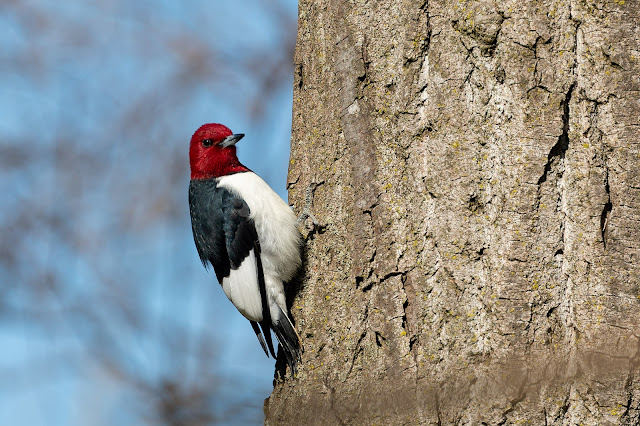
 We haven't seen a red-head for about two weeks. We hear then most days, but they have been shy, Rondeau Provincial Park, Ontario, Canada, August 7, 2025. Melanerpes erythrocephalus The Red-headed Woodpecker is one of only four North American woodpeckers known to store food, and it is the only one known to cover the stored food with wood or bark. It hides insects and seeds in cracks in wood, under bark, in fenceposts, and under roof shingles. Grasshoppers are regularly stored alive, but wedged into crevices so tightly that they cannot escape.

The glamour bird

Image
  Red-headed woodpecker visiting the yard this afternoon, I think they are one of the most elegant bids we see. Rondeau Provincial Park. Ontario, Canada, July 13, 2025. Melanerpes erythrocephalus The Red-headed Woodpecker benefited from the chestnut blight and Dutch elm disease outbreaks of the twentieth century. Though these diseases devastated trees they provided many nest sites and foraging opportunities for the woodpeckers.

Red-headed woodpecker.

Image
  One of my favourite birds that visit the yard. Rondeau Provincial Park, Ontario, Canada, May 24, 2023. Melanerpes erythrocephalus The Red-headed Woodpecker is one of only four North American woodpeckers known to store food, and it is the only one known to cover the stored food with wood or bark. It hides insects and seeds in cracks in wood, under bark, in fenceposts, and under roof shingles. Grasshoppers are regularly stored alive, but wedged into crevices so tightly that they cannot escape. Source, all bout birds org
They're back.

Image
Red-headed woodpecker, Rondeau Provincial Park, May 7, 2023. We finally have a pair of red-heads back in the yard. Hopefully the will nest in the trees behind us again. Melanerpes erythrocephalus. The Red-headed Woodpecker is one of only four North American woodpeckers known to store food, and it is the only one known to cover the stored food with wood or bark. It hides insects and seeds in cracks in wood, under bark, in fenceposts, and under roof shingles. Grasshoppers are regularly stored alive, but wedged into crevices so tightly that they cannot escape. source - allaboutbird-org.

Red-headed Woodpecker

Image
Immature red-headed woodpecker, Rondeau Provincial Park, Aug 1, 2022. Melanerpes erythrocephalus The Red-headed Woodpecker has many nicknames, including half-a-shirt, shirt-tail bird, jellycoat, flag bird, and the flying checker-board.

Red-headed woodpecker

Image
May 21, 2017, Rondeau Provincial Park, Ontario, Canada. Going through some older photos and came across this one. Melanerpes erythrocephalus The Red-headed Woodpecker is one of only four North American woodpeckers known to store food, and it is the only one known to cover the stored food with wood or bark. It hides insects and seeds in cracks in wood, under bark, in fenceposts, and under roof shingles. Grasshoppers are regularly stored alive, but wedged into crevices so tightly that they cannot escape. source- Cornell Lab of Ornithology.

Red-headed woodpecker at the water feature.

Image
Rondeau Provincial Park, Ontario, Canada, May 19, 2021. Melanerpes erythrocephalus The gorgeous Red-headed Woodpecker is so boldly patterned it’s been called a “flying checkerboard,” with an entirely crimson head, a snow-white body, and half white, half inky black wings. These birds don’t act quite like most other woodpeckers: they’re adept at catching insects in the air, and they eat lots of acorns and beech nuts, often hiding away extra food in tree crevices for later. Source -Cornell Lab of Ornithology- All About Birds

Disputed territory.

Image
A red-belled woodpecker stood his ground when a red-headed woodpecker swooped into his perch. Rondeau Provincial Park, Ontario, Canada, June 19, 2021. Red-bellied Woodpecker Melanerpes carolinus Red-headed Woodpecker Melanerpes erythrocephalus

The grape eater

Image
Red-headed woodpecker, July 13, 2020, Rondeau Provincial Park, Ontario Canada. Came in for the grapes. Melanerpes erythrocephalus The gorgeous Red-headed Woodpecker is so boldly patterned it’s been called a “flying checkerboard,” with an entirely crimson head, a snow-white body, and half white, half inky black wings. These birds don’t act quite like most other woodpeckers: they’re adept at catching insects in the air, and they eat lots of acorns and beech nuts, often hiding away extra food in tree crevices for later.

Red-headed woodpecker.

Image
Red-headed woodpecker in the yard June 5, 2020. Rondeau Provincial Park, Ontario, Canada. Melanerpes erythrocephalus The Red-headed Woodpecker is one of only four North American woodpeckers known to store food, and it is the only one known to cover the stored food with wood or bark. It hides insects and seeds in cracks in wood, under bark, in fenceposts, and under roof shingles. Grasshoppers are regularly stored alive, but wedged into crevices so tightly that they cannot esca pe. source -  https://www.allaboutbirds.org/guide/Red-headed_Woodpecker

Red-headed woodpecker

Image
May 13, 2020, Rondeau Provincial Park, Ontario, Canada. The red-head finally came back to the yard. We had one until mid February then it disappeared. Melanerpes erythrocephalus Pleistocene-age fossils of Red-headed Woodpeckers—up to 2 million years old—have been unearthed in Florida, Virginia, and Illinois. source - https://www.allaboutbirds.org/guide/Red-headed_Woodpecker
Image
Red-headed woodpecker, Rondeau Provincial Park, Ontario, Canada, Jan 6, 2020. Still hanging around and coming to the feeders every day. First time we have had one over winter. Melanerpes erythrocephalus Red-headed Woodpeckers are fierce defenders of their territory. They may remove the eggs of other species from nests and nest boxes, destroy other birds’ nests, and even enter duck nest boxes and puncture the duck eggs.

A late visitor.

Image
Red-headed woodpecker, Nov 5, 2019, Rondeau Provincial Park, Ontario, Canada. According to our records this is the latest that we have had a red-headed woodpecker in the yard. It is very cautious and it takes two or three passes before it will settle on the feeder. Through the Wonderful Wildlife Window. Melanerpes erythrocephalus The Red-headed Woodpecker is one of only four North American woodpeckers known to store food, and it is the only one known to cover the stored food with wood or bark. It hides insects and seeds in cracks in wood, under bark, in fence posts, and under roof shingles. Grasshoppers are regularly stored alive, but wedged into crevices so tightly that they cannot escape. source - Cornell Lab of Ornithology.

Shirt-tailed bird.

Image
Red-headed woodpecker, Rondeau Provincial Park, Ontario, Canada, May 21, 2019. We have had four red-headed woodpeckers in and around our yard for several days. At least two are nesting in the large trees just off our lot. Melanerpes erythrocephalus Red-headed Woodpeckers are fierce defenders of their territory. They may remove the eggs of other species from nests and nest boxes, destroy other birds’ nests, and even enter duck nest boxes and puncture the duck eggs. source -  https://www.allaboutbirds.org/guide/Red-headed_Woodpecker

Red-headed woodpecker, immature.

Image
Most of the adults have stopped feeding young birds. It is fun to watch the youngsters try to figure out the feeders. This is an immature redheaded woodpecker. Melanerpes erythrocephalus Immatures have gray-brown heads, and the white wing patches show rows of black spots near the trailing edge. Adults have bright-red heads, white underparts, and black backs with large white patches in the wings, making the lower back appear all white when perched source - https://www.allaboutbirds.org/guide/Red-headed_Woodpecker/id

Just another red-headed woodpecker shot.

Image
You will have to put up with more red headed woodpecker photos. We had 3 in the yard today and they were not playing well. I figure two are males and are trying to figure out who is dominant. That photo is for another day. Melanerpes erythrocephalus Pleistocene-age fossils of Red-headed Woodpeckers—up to 2 million years old—have been unearthed in Florida, Virginia, and Illinois.
Image
Red-headed woodpecker at Rondeau Provincial Park. Red headed woodpeckers continue coming into the suet feeders in the yard.  This was cropped to create a close up but has no other editing. Melanerpes erythrocephalus Red-headed Woodpeckers are fierce defenders of their territory. They may remove the eggs of other species from nests and nest boxes, destroy other birds’ nests, and even enter duck nest boxes and puncture the duck eggs.

Changing of the guard.

Image
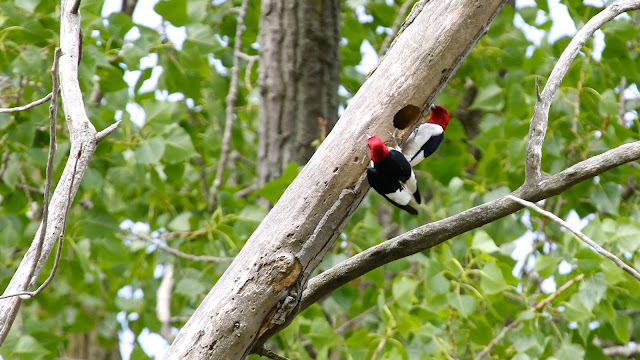
A pair of nesting red headed woodpeckers trade places at the nest hole. Melanerpes erythrocephalus The Red-headed Woodpecker has many nicknames, including half-a-shirt, shirt-tail bird, jellycoat, flag bird, and the flying checker-board.

Out on a limb.

Image
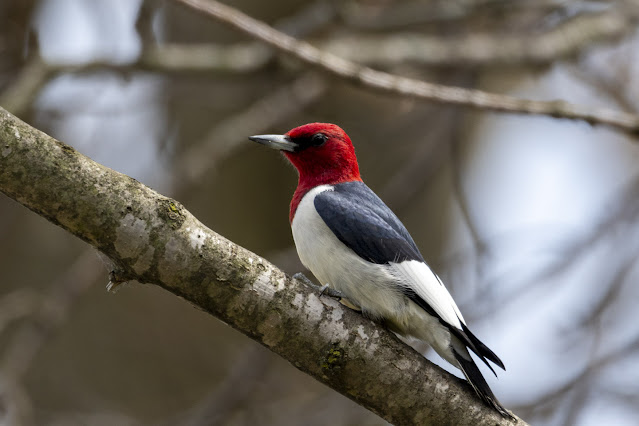
After a 3 week absence the red-headed woodpeckers are coming back to our yard and the empty lot next door. I find them striking in their simplicity,red, black and white. Melanerpes erythrocephalus The Red-headed Woodpecker is one of only four North American woodpeckers known to store food, and it is the only one known to cover the stored food with wood or bark. It hides insects and seeds in cracks in wood, under bark, in fenceposts, and under roof shingles. Grasshoppers are regularly stored alive, but wedged into crevices so tightly that they cannot escape. Pleistocene-age fossils of Red-headed Woodpeckers—up to 2 million years old—have been unearthed in Florida, Virginia, and Illinois. source - Cornell Lab of Ornithology

banding a red headed

Image
banding a red headed , a photo by ricmcarthur on Flickr. A red headed woodpecker int he hand, WOW! This banding experience has been great. The birds are caught in "mist" nets then carefully removed by experienced banders. A band is attached to the leg, the number recorded and various measurements taken. The bird is released and if it is caught again the tag number can be used to access information on the bird. How old it is, where it came from etc.