Posts

Showing posts with the label Piranga olivacea

The mystery bird.

Image
  We were unable to identify this young bird. Our various field guides don't show immature birds and the Merlin app couldn't identify it either. Thanks to a lot of people responding to an enquiry on Ontario Birds we found out it is an immature scarlet tanager. Rondeau Provincial Park, Ontario, Canada, July 6, 2025. Piranga olivacea The oldest Scarlet Tanager on record was a male, and at least 11 years, 11 months old. He was banded in Pennsylvania in 1990 and found in Texas in 2001.

Scarlet Tanager.

Image
 The spring and fall plumage is entirely different on this bird. I am red/green spectrum impaired ( fancy for colour blind) and I thought people were messing with me when I started birding and they were telling me both are male tanager. May 10, 2014, Rondeau Provincial Park, Ontario, canada. September 21, 2024, Rondeau Provincial Park, Ontario, Canada. Piranga olivacea In fall, males trade red feathers for yellow-green and the birds take off for northern South America. Male Scarlet Tanagers are among the most blindingly gorgeous birds in an eastern forest in summer, with blood-red bodies set off by jet-black wings and tail

Scarlet tanager

Image
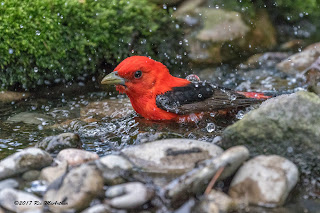
Fall plumage, enjoying a bath in the little water feature. Rondeau Provincial Park, Ontario, Canada, Sept 7, 2021. Piranga olivacea The response of the Scarlet Tanager to habitat fragmentation varies from place to place. Results from the Cornell Lab’s Project Tanager indicate that in the heart of the species’ range in the Northeast, it can be found in small forest patches. In the Midwest, similar sized forest patches tend to have no tanagers. source -Cornell Lab of Ornithology.

Scarlet tanager

Image
Sept 19, 2020, Rondeau Provincial Park, Ontario, Canada. Another fall visitor at the pond. Piranga olivacea The response of the Scarlet Tanager to habitat fragmentation varies from place to place. Results from the Cornell Lab’s Project Tanager indicate that in the heart of the species’ range in the Northeast, it can be found in small forest patches. In the Midwest, similar sized forest patches tend to have no tanagers.

One wing landing?

Image
Scarlet tanager, May 17, 2019, Rondeau Provincial Park, Ontario, Canada. Piranga olivacea The response of the Scarlet Tanager to habitat fragmentation varies from place to place. Results from the Cornell Lab’s Project Tanager indicate that in the heart of the species’ range in the Northeast, it can be found in small forest patches. In the Midwest, similar sized forest patches tend to have no tanagers.

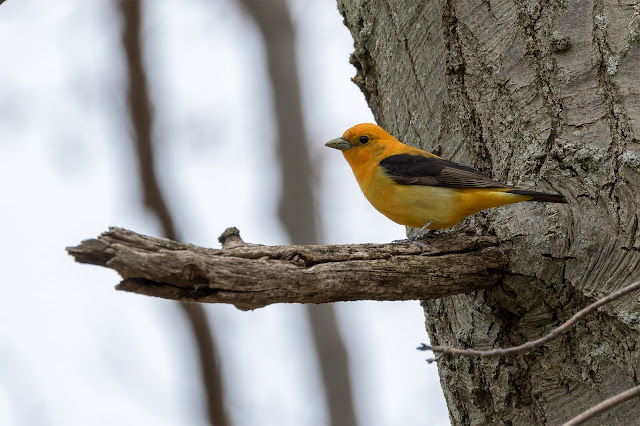
Orange variant scarlet tanager.

Image
Scarlet tanager, male orange variant, Rondeau Provincial Park, Ontario, Canada, May 17, 2019. This bird was reported as a orange variant but I can't find much on the different colouration. Feel free to comment as to the difference from the standard colouration - in molt, true variation and so on. Piranga olivacea

New and improved.

Image
Needed a new a pump for the pond/stream which necessitated rearranging the rocks and bits and pieces. At first I bought a 1500 gallon per hour pump. Quickly realized I wanted 1500 litre per hour pump. The 1500 gph would have shot the water out of the pool and half way across the yard. I don't think woodland birds like to surf. Piranga olivacea The female Scarlet Tanager sings a song similar to the male's, but softer, shorter, and less harsh. She sings in answer to the male's song and while she is gathering nesting material. source -  https://www.allaboutbirds.org/g…/Scarlet_Tanager/lifehistory

Scarlet Tanager

Image
I think Scarlet tanagers are a stunning bird.  Bright red with black wings, simple but elegant. Piranga olivacea The female Scarlet Tanager sings a song similar to the male's, but softer, shorter, and less harsh. She sings in answer to the male's song and while she is gathering nesting material. The oldest Scarlet Tanager on record was nearly 12 years old. source - Cornell Lab of Ornithology.

Dichotomy

Image
This scarlet tanager, I think it is a male juvenile , is a complete contrast to its breeding plumage. This one dropped by to have a drink and a bath before continuing its migration to warmer climes for the winter. This is the male in breeding plumage. If you can confirm the id as either male, immature or female please let me know. Piranga olivacea On the wintering grounds in South America the Scarlet Tanager joins mixed species foraging flocks with flycatchers, antbirds, woodcreepers, and resident tropical tanagers. The oldest Scarlet Tanager on record was nearly 12 years old. source - - Cornell Lab of Ornithology.

A black winged red bird.

Image
As compared to a red winged black bird. We had scarlet tanagers passing through earlier in the spring and, as usual I was captivated by their intense colour. This is a bird that should make you do a double take. Piranga olivacea On the wintering grounds in South America the Scarlet Tanager joins mixed species foraging flocks with flycatchers, antbirds, woodcreepers, and resident tropical tanagers. The female Scarlet Tanager sings a song similar to the male's, but softer, shorter, and less harsh. She sings in answer to the male's song and while she is gathering nesting material. source- Cornell Lab of Ornithology.

Ant eater

Image
This scarlet tanager was busily eating ants and didn't care who saw him. He stayed on the ground for at least 10 minutes, in among the wild flowers. Such an intense colour. Piranga olivacea Scarlet Tanagers often play host to eggs of the Brown-headed Cowbird, particularly where the forest habitat has been fragmented. When a pair of tanagers notices a female cowbird approaching, they aggressively drive her away. If they don’t notice, the cowbird gets rid of a tanager egg and replaces it with one of her own. The tanagers apparently can’t tell the difference, either before or after the egg hatches, and they raise the imposter along with the rest of their brood. The oldest Scarlet Tanager on record was nearly 12 years old.