Posts

Showing posts with the label pond

An ear-full of cedar waxwings.

Image
 Seven of the 13+ waxwings that descended on, and took over, our little water feature this evening. This lasted about 2 minutes and then they were gone. We have has 2-3 at a time before but nothing like this. Rondeau Provincial Park, Ontario, Canada, May 29, 2025 Bombycilla cedrorum The Cedar Waxwing is one of the few North American birds that specializes in eating fruit. It can survive on fruit alone for several months. Brown-headed Cowbirds that are raised in Cedar Waxwing nests typically don’t survive, in part because the cowbird chicks can’t develop on such a high-fruit diet. The collective nouns for a flock of Cedar Waxwings are " ear-full " and "museum."
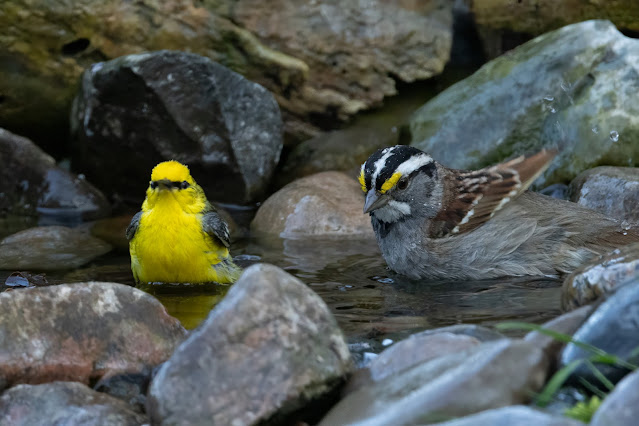
Size comparison

Image
 Not a great photo but it was almost dark and sometimes you have to use what you got. The white-throated weighs in at approximately .7 to 1.3 ounces and is about 15 to 19 centimetres (5.9 to 7.5 inches) in length. The blue-winged warbler weighs around 0.3 ounce and is in the 11-12 cm (4.3 to 4.7 inch) in length. Rondeau Provincial Park, Ontario, Canada, May 2, 2024.

No room at the pond.

  A very large number of yellow-dumped warblers descended on our little water feature today . This went on for about 20 minutes, then everything left only to come back about an hour later to repeat the action. Rondeau Provincial Park, Ontario, Canada, October 19, 2023.

To taste the water.

Image
No it isn't a bird, but I do take other images soon occassion. This garter snake stopped by the pond for a taste before continuing on its way. Rondeau Provincial Park, May 15, 2023.

Before the big freeze.

Image
This was the stream on Dec 23, 2022 before the big storm. We lost power for 4 days, thank goodness for our back-up generator. The pond is completely frozen over, not sure if the pump survived. Temperature was -17c (1.4f) with windchills of -25c(-13f). The big problem was the wind. It shook the cottage for 3 days and whipped up monster drifts and took down a lot of trees. Just above freezing now and forecast to get to 10c (60f) tomorrow. Hope everyone had a good Christmas.

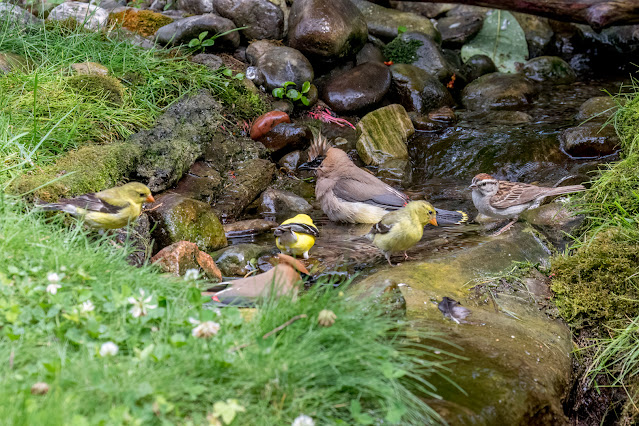
A full house.

Image
The water feature has been getting a lot of action with the dry hot weather. This handful is 1 chipping sparrow, 2 cedar waxwings, 3 goldfinches. Over the last 15 to 20 years we have had at least 102 species in, at, or within a few feet of the water. Rondeau Provincial Park, July 12, 2022.

Had a midge bloom recently.

Image
A midge is any small fly, including species in several families of non-mosquito. A very small sample ended up in the stream/pond in the yard. It got worse as the evening progressed. They feed the birds and they don't bite, just keep your mouth closed.

Yellow warbler

Image
Rondeau Provincial Park, Ontario, Canada, Sept 23, 2020. At our small water feature just prior to having a bath. Setophaga petechia In addition to the migratory form of the Yellow Warbler that breeds in North America, several other resident forms can be found in Mexico, Central America, and the Caribbean. Males in these populations can have chestnut caps or even chestnut covering the entire head. The oldest-known Yellow Warbler was a female, and was at least 11 years old. source - https://www.allaboutbirds.org/guide/Yellow_Warbler

The slow freeze.

Image
Early January and the pond is still open but it is slowly falling under winter's grip. Birds and mammals are still getting drinks. Rondeau Provincial Pak, Ontario, Canada, Jan 9, 2021

Bubble bath.

Image
In the little pond in the yard. Rondeau Provincial Park, Ontario, Canada, August 27, 2020.

Eastern towhee, July 5, 2020.

Image
At the pond, Rondeau Provincial Park, Ontario, Canada. Pipilo erythrophthalmus The oldest known Eastern Towhee was a male in South Carolina, and at least 12 years, 3 months old.

Pine warbler

Image
April 27, 2020, Rondeau Provincial Park, Ontario, Canada. Final a warbler showed up in our yard this year. It was coming to the suet, peanut feeders, and nicer feeders. Setophaga pinus The Pine Warbler is the only warbler that eats large quantities of seeds, primarily those of pines. This seed-eating ability means Pine Warblers sometimes visit bird feeders, unlike almost all other warblers.

Purple finch.

Image
Rondeau Provincial Park, Ontario, Canada. Still going through the archives. Haemorhous purpureus The Purple Finch uses its big beak and tongue to crush seeds and extract the nut. They do a similar trick to get at nectar without eating an entire flower, and also to get to a seed buried inside a fleshy fruit.

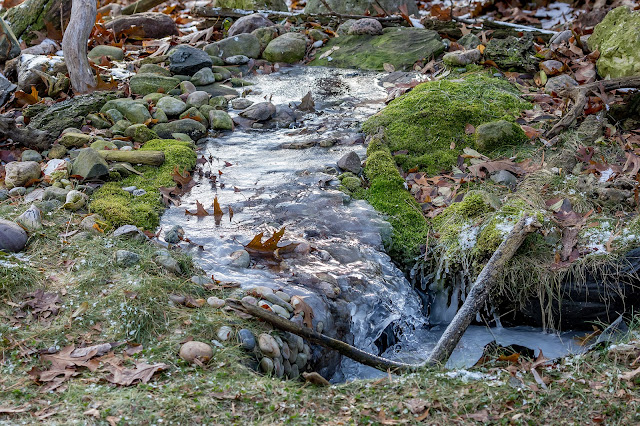
Not a warbler in sight.

Image
December 12, 2019. The pond and stream froze over last night. The water was still running under the ice. Warmer temperatures tonight and tomorrow but it is getting close to the end of the season.

Eastern towhee.

Image
Eastern Towhee, Rondeau Provincial Park, Ontario, Canada, Nov 5, 2019. A female or immature eastern towhee in the pond earlier this month. Pipilo erythrophthalmus Eastern Towhees tend to be pretty solitary, and they use a number of threat displays to tell other towhees they’re not welcome. You may see contentious males lift, spread, or droop one or both wings, fan their tails, or flick their tails to show off the white spots at the corners. Studies have shown that male towhees tend to defend territories many times larger than needed simply to provide food.

Brown creeper

Image
Brown creeper, Nov 14, 2019, Rondeau Provincial Park, Ontario, Canada. A slightly grainy image of a brown creeper having a bath. First time I have seen one in the water. Certhia americana Brown Creepers burn an estimated 4–10 calories (technically, kilocalories) per day, a tiny fraction of a human’s daily intake of about 2,000 kilocalories. By eating a single spider, a creeper gains enough energy to climb nearly 200 feet vertically. source - Cornell Lab of Ornithology.

What a difference a day can make.

Image
Birds are hiding in the snow laden hedge, water is still flowing in the water feature. Rondeau Provincial Park, Nov 12, 2019, Ontario, Canada.

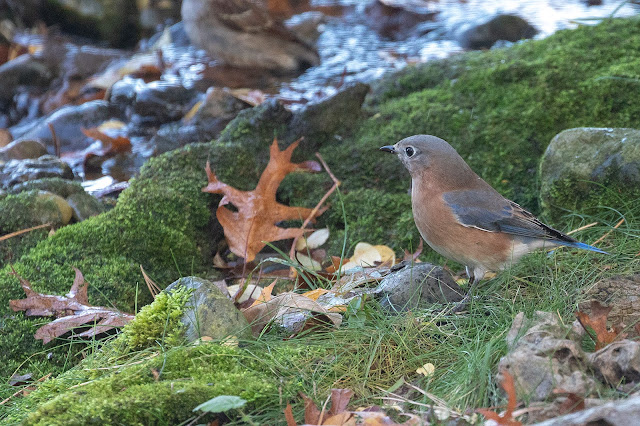
Another through the window image.

Image
Eastern bluebird, Nov 9, 2019, Rondeau Provincial Park, Ontario, Canada. Sialia sialis Eastern Bluebirds eat mostly insects, wild fruit and berries. Occasionally, Eastern Bluebirds have also been observed capturing and eating larger prey items such as shrews, salamanders, snakes, lizards and tree frogs.

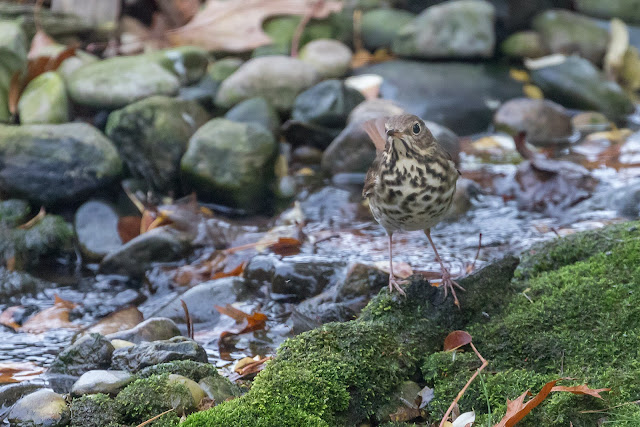
Hermit thrush.

Image
Hermit thrush, Nov 4, 2019, Rondeau Provincial Park, Ontario, Canada. Late in the day we had a flurry of birds, including this hermit thrush, coming into the water feature in the yard. Catharus guttatus Hermit Thrushes sometimes forage by “foot quivering,” where they shake bits of grass with their feet to get insects. They also typically begin to quiver their feet as they relax after seeing a flying predator. Some scientists think the quivering happens as the bird responds to conflicting impulses to resume foraging or continue taking cover. source - Cornell Lab of Ornithology.

Black and white warbler.

Image
Black and white warbler, sept 29, 2019, Rondeau Provincial Park, Ontario, Canada. The birds are using the pond as a splash pad, everybody gets wet. Mniotilta varia Black-and-white Warblers have an extra-long hind claw and heavier legs than other wood-warblers, which help them hold onto and move around on bark.