Posts

Showing posts with the label Seiurus aurocapilla

Ovenbird

Image
 We had a very good day for warblers. Thirteen species with photographs of all but one. Not vey often get that many wailers in one day. Rondeau Provincial Park, Ontario, Canada, September 3, 2025. Seiurus aurocapilla The Ovenbird female weaves the cup, side entrance, and roof of her domed nest from the inside as a single, integrated piece. Then she drops leaves and twigs on top to hide it. If the chicks inadvertently dismantle the dome as they grow, the female ignores the damage.

A slow day.

Image
Only 9 warbler species today. Ovenbird, Rondeau Provincial Park, Aug 19, 2022. Not a common visitor to the yard. Seiurus aurocapilla . The Ovenbird female weaves the cup, side entrance, and roof of her domed nest from the inside as a single, integrated piece. Then she drops leaves and twigs on top to hide it. If the chicks inadvertently dismantle the dome as they grow, the female ignores the damage. source - https://www.allaboutbirds.org/guide/Ovenbird/ #

Ovenbird

Image
Rondeau Provincial Park, Ontario, Canada, Sept 27, 2021. We have had ovenbirds for the last two days, not rare but not common in the yard. Seiurus aurocapilla The Ovenbird gets its name from its covered nest. The dome and side entrance make it resemble a Dutch oven.

Ovenbird,

Image
May 6, 2018, Rondeau Provincial Park, Ontario, Canada. Not much showing up in the area as far as warblers are concerned so this is from 2 years ago. Seiurus aurocapilla The Ovenbird female weaves the cup, side entrance, and roof of her domed nest from the inside as a single, integrated piece. Then she drops leaves and twigs on top to hide it. If the chicks inadvertently dismantle the dome as they grow, the female ignores the damage. source - https://www.allaboutbirds.org/guide/Ovenbird/
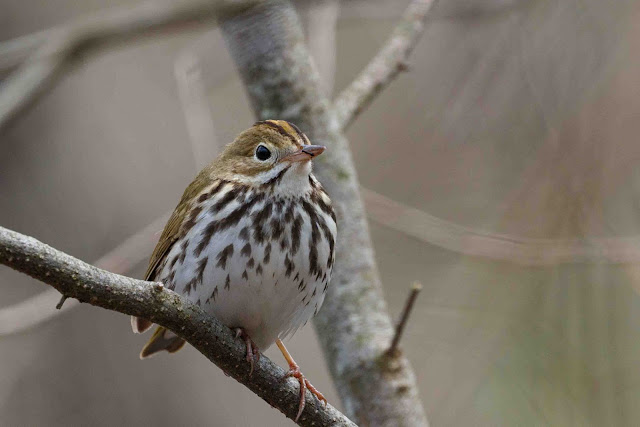
Ovenbird

Image
Ovenbird, Rondeau Provincial Park, May 6, 2018. A nice find on a slow bird migration day. Seiurus aurocapilla The Ovenbird female weaves the cup, side entrance, and roof of her domed nest from the inside as a single, integrated piece. Then she drops leaves and twigs on top to hide it. If the chicks inadvertently dismantle the dome as they grow, the female ignores the damage. source -  https://www.allaboutbirds.org/guide/Ovenbird/
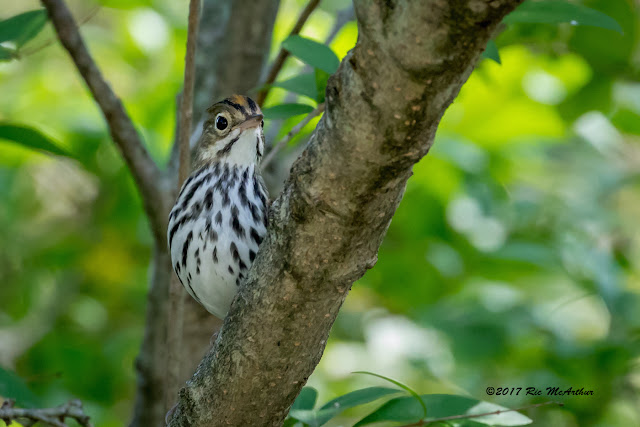
A summer reminder.

Image
Ovenbird at Rondeau Provincial Park. Usually down low skulking in the vegetation, this one popped up and into the open for a minute. Seiurus aurocapilla The Ovenbird gets its name from its covered nest. The dome and side entrance make it resemble a Dutch oven.

An embarrassment of riches.

Image
We don't often see ovenbirds and then usually just glimpses. Today was different, we had one visit and perch in the open. I have so many good photos I didn't know which one to pick. This is one of the best ovenbird photos I took. Seiurus aurocapilla On its breeding ground, the Ovenbird divides up the forest environment with the other warblers of the forest floor. The Ovenbird uses the uplands and moderately sloped areas, the Worm-eating Warbler uses the steep slopes, and the Louisiana Waterthrush and the Kentucky Warbler use the low-lying areas. source - https://www.allaboutbirds.org/guide/Ovenbird/lifehistory

Imagine my surprise.

Image
I thought I was taking a photo of a wood thrush, turns out it was an ovenbird. Bonus. Rondeau Provincial Park. Seiurus aurocapilla Neighboring male Ovenbirds sing together. One male starts singing, and the second will join in immediately after. They pause, and then sing one after the other again, for up to 40 songs. The second joins in so quickly that they may sound from a distance as if only one bird is singing. Ovenbirds rarely overlap the song of their neighbors. source - Cornell Lab of Ornithology