Posts

Showing posts with the label texas

Twins.

Image
Royal terns, Texas, Jan 24, 2012. Big east wind for the 3rd day which means fewer birds in the yard. This is from the archives. Thalasseus maximus Royal Tern chicks leave the nest scrape within one day after hatching and congregate in a group known as a crèche (“nursery”), which can contain thousands of chicks ranging in age from 2–35 days old. Each Royal Tern parent feeds only its own chick, finding it in the crowd probably by recognizing its call.

The armoured division.

Image
An armadillo foraging in the grass near some bird feeders in Texas. Jan 25, 2012. Still overcast and cold here so I'm looking through old images. The armadillo, in fact, is the state small mammal of Texas. Their life span is usually 12 to 15 years. Their armor-like skin appears to be their main defense, However, many armadillos escape predators by fleeing (often into thorny patches, from which their armor protects them) or digging to safety. Dasypus novemcinctus linnaeus

White eyed vireo,

Image
Texas, Jan 20, 2012. Vireo griseus Both the male and the female White-eyed Vireo sing on the wintering grounds, but only the male sings on the breeding grounds.

White pelican

Image
This is from our 2011 trip to Texas. Pelecanus erythrorhynchos American White Pelicans cooperate when feeding. Sometimes, large groups gather in wetlands. They coordinate their swimming to drive schooling fish toward the shallows. The pelicans can then easily scoop up these corralled fish from the water.

Portuguese Man-of-War

Image
This is a Portuguese Man-of-War that we saw in texas a few years back. They are venomous and are to be avoided. Anyone unfamiliar with the biology of the venomous Portuguese man-of-war would likely mistake it for a jellyfish. Not only is it not a jellyfish, it's not even an "it," but a "they." The Portuguese man-of-war is a siphonophore, an animal made up of a colony of organisms working together. Physalia physalis

Eastern meadowlark

Image
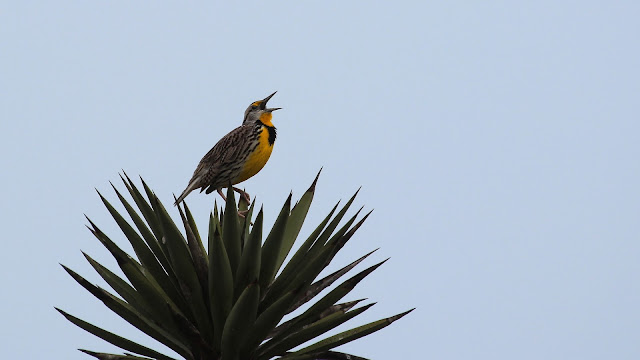
This is an Eastern meadowlark    that we saw in Texas back in 2012 at Laguna Atascosa National Wildlife Refuge. Sturnella magna The oldest known wild Eastern Meadowlark was at least 8 years, 8 months old.
Image
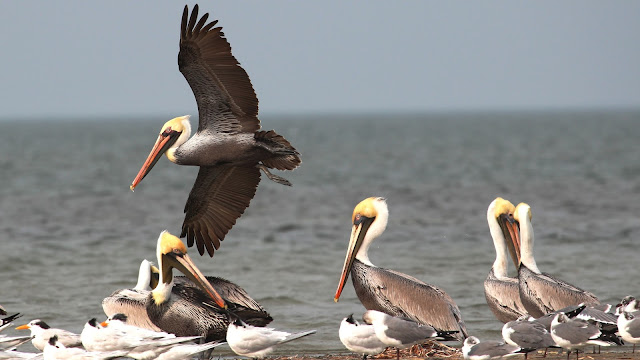
This is from our Texas trip in 2012. Somewhere along the gulf coast. Pelecanus occidentalis While the Brown Pelican is draining the water from its bill after a dive, gulls often try to steal the fish right out of its pouch—sometimes while perching on the pelican's head. The oldest Brown Pelican on record was 43 years of age.
Image
We saw this heron in Texas 3 years ago. It was roosting with roseate spoonbills. Nyctanassa violacea

Immature caracara

Image
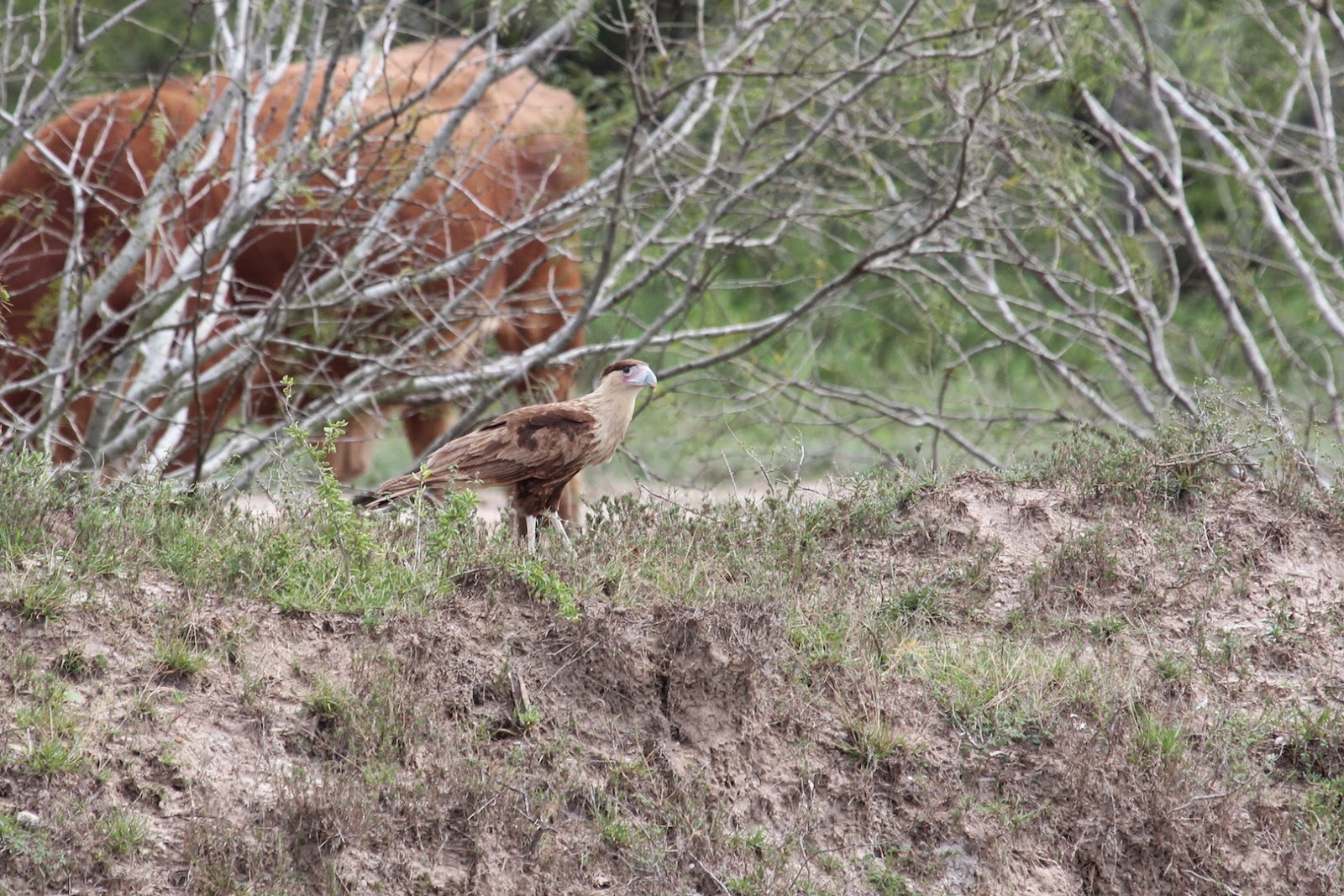
We saw several immature caracaras at the Brownsville dump. This is a great birding spot in Texas. Sewage lagoons are also good birding spots. Birders go to the nicest places. Caracara cheriway A tropical falcon version of a vulture, the Crested Caracara reaches the United States only in Arizona, Texas, and Florida. It is a bird of open country, where it often is seen at carrion with vultures. Although it looks like a long-legged hawk and associates with vultures, the Crested Caracara is actually in the same family as falcons. source - Cornell Lab of Ornithology.

Sushi

Image
I don't think you are supposed to eat the whole thing at once. Maybe it is different for egrets. Ardea alba  Though it mainly hunts while wading, the Great Egret occasionally swims to capture prey or hovers (somewhat laboriously) over the water and dips for fish. Great Egrets fly slowly but powerfully: with just two wingbeats per second their cruising speed is around 25 miles an hour.

Black-necked stilt.

Image
We saw this long legged fellow in Texas a few years ago. We had one as a rare visitor in December on the St. Clair River about 6 years ago, which is well out of its normaal range. The St. Clair is part of the Great Lakes system in north America. Himantopus mexicanus Five species of rather similar-looking stilts are recognized in the genus Himantopus. They have the second-longest legs in proportion to their bodies of any bird, exceeded only by flamingos.

Some names make sense.

Image
At least this name matches the bird in question. Compared to its large size the tail is huge and can make you do a double take. That combined with the penetrating stare can really grab your attention. We saw this one in Texas a few years ago. The males are about twice the size of the rich brown females. Quiscalus mexicanus In winter, enormous flocks of both male and female Great-tailed Grackles gather in “roost trees.” These winter roosts can contain thousands of individuals, with flocks of up to half a million occurring in sugarcane fields in Texas’s Rio Grande Valley. The oldest Great-tailed Grackle (based on banding records) was 7 years 9 months. source - Cornell Lab of Ornithology.

Royal Tern

Image
A large, orange-billed tern, the Royal Tern is found only along ocean beaches. We saw this one on the gulf coast in Texas. The Royal Tern makes its nest scrape on the ground on low-lying islands. The pair defecates directly on the nest rim, perhaps to reinforce the nest against flooding. After a few weeks, the nest rim hardens. Thalasseus maximus
Image
At High Island Texas, which isn't an island, there is a rookery where roseate spoonbills and great egrets nest. There is a viewing area that is close to the nests and you can get good looks and photos. High Island is the surface expression of a salt dome at the edge of the Gulf of Mexico. Platalea ajaja A bizarre wading bird of the southern coasts, the Roseate Spoonbill uses its odd bill to strain small food items out of the water. Its bright pink coloring leads many Florida tourists to think they have seen a flamingo.

Armoured division

Image
Armoured division , a photo by ricmcarthur on Flickr. his is a nine-banded armadillo that we saw in Texas. I thought you might appreciate a break from birds and/or winter.The one thing that tells everyone they are looking at an armadillo is the roly-poly shell with what are called "armoured" bands. The number of bands depends on the species. The pleated look of most armadillos is made of these hardened, overlapping sections. Although the bands are tough like fingernails, the shell is flexible, with softer skin that expands and contracts between the bands. Armadillos also have long claws for digging and foraging for food. Their peg-shaped teeth crunch through the bodies of insects, an armadillo's favourite food. Armadillo is Spanish for little armoured thing. Part of the armadillo's family name Dasypodidae, “dasypus,” is Greek for rabbit. The nine-banded armadillo has four identical pups in every litter.

Great tailed grackle

Image
Great tailed grackle , a photo by ricmcarthur on Flickr. These birds are absolute monsters compared to the common grackle we get in our area. The Cornell Lab of Ornithology describes them as "A big, brash blackbird, the male Great-tailed Grackle shimmers in iridescent black and purple, and trails a tail that will make you look twice." We saw these birds at Laguna Atascosa National Wildlife Refuge. Laguna is also the place where we first was road runners. Quiscalus mexicanus Although you’ll usually see them feeding on land, Great-tailed Grackles may also wade into the water to grab a frog or fish. In winter, enormous flocks of both male and female Great-tailed Grackles gather in “roost trees.” These winter roosts can contain thousands of individuals, with flocks of up to half a million occurring in sugarcane fields in Texas’s Rio Grande Valley.

All dressed up

Image
All dressed up , a photo by ricmcarthur on Flickr. This is a cattle egret all dressed up in his breeding plumage. We saw this one on a birding trip to Texas. Cattle Egrets are native to Africa but somehow reached northeastern South America in 1877. They continued to spread, arriving in the United States in 1941 and nesting there by 1953. In the next 50 years they became one of the most abundant of the North American herons, showing up as far north as Alaska and Newfoundland. The oldest Cattle Egret on record, originally banded in Maryland, was at least 17 years old when it was captured and released in Pennsylvania in 1979. Bubulcus ibis

Come on in, the waters fine.

Image
Come on in, the waters fine. , a photo by ricmcarthur on Flickr. Just watch our for the gator lurking in the duck weed. We saw this alligator in Texas at a state park. He was in what looked like an old watering trough Scientific stuff Alligator mississippiensis The largest American alligator ever reported was supposedly 19.8 ft (6 m) long, although there are doubts about the claim. Hatchlings are 6 to 8 inches (15 to 20 centimeters) long with yellow and black stripes. Juveniles, which are on the menu for dozens of predators, including birds, raccoons, bobcats, and even other alligators, usually stay with their mothers for about two years.

Candelabra

Image
Candelabra , a photo by ricmcarthur on Flickr. Half the bulbs are not turned on. I think this is a type of prickly pear cactus. We saw them with red or yellow flowers. We have a yellow variety in southern Ontario, probably the very edge of their range. The Eastern Prickly Pear Cactus (Opuntia humifusa) is what we get. While looking for information on the plant I came across this entry - How to Eat Prickly Pear Cactus The answer is obvious - very carefully. Odd fact - like all true cactus species, prickly pears are native only to the Western hemisphere

Shared resource.

Image
Shared resource. , a photo by ricmcarthur on Flickr. Both need a place to haul out and bask. Only one log in the pond. Fortunately the turtles seem to be too large to be considered food by the alligator.