Posts

Showing posts with the label baltimore oriole

The oriole cousins.

Image
 It isn't unusual to have Baltimore and orchard orioles at the water. It was unusual to get both at the same time and to get them both in focus. Rondeau Provincial Park, Ontario, Canada, June 30, 2025. Baltimore oriole, in foreground -Icterus galbula Orchard oriole in background -Icterus spurius
Hitchin' a ride.

Image
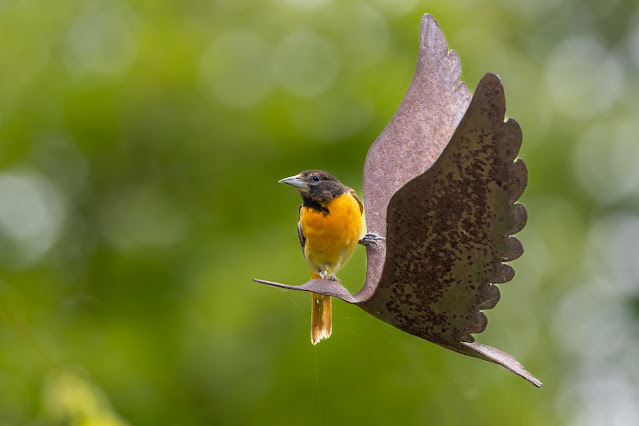
Baltimore oriole, Rondeau Provincial Park, June 29, 2023. Removed the sculpture support in photoshop. Alternate title - Surfin' Bird Icterus galbula. Baltimore Orioles sometimes use their slender beaks to feed in an unusual way, called “gaping”: they stab the closed bill into soft fruits, then open their mouths to cut a juicy swath from which they drink with their brushy-tipped tongues. source - allaboutbirds-org.

Baltimore oriole

Image
Baltimore oriole, Rondeau Provincial Park, Ontario, Canada, June 13, 2023. Enjoying his bath time. Icterus galbula Unlike robins and many other fruit-eating birds, Baltimore Orioles seem to prefer only ripe, dark-colored fruit. Orioles seek out the darkest mulberries, the reddest cherries, and the deepest-purple grapes, and will ignore green grapes and yellow cherries even if they are ripe.

An explosion of colour.

Image
Baltimore oriole launching from the water feature in the yard. Rondeau Provincial Park June 28, 2023.

A tail of two orioles.

Image
Orchard oriole and Baltimore oriole, June 28, 2023, Rondeau Provincial Park. A size comparison of the two orioles. Icterus spurius, Icterus galbula

Lots of colour.

Image
Baltimore oriole and a rose-breasted grosbeak in the water. Rondeau Provincial Park, June 10, 2023.

A good day at Rondeau Provincial Park.

Image
Adult male Baltimore oriole, April 24, 2022. Among others we also had, an orchard oriole, ruby-throated hummingbird, and an eastern kingbird. Many other species reported in the park including summer tanager, worm eating warbler, black and white warbler, blue gray gnat catcher, black-throated green, and a red-headed woodpecker. Icterus galbula Baltimore Orioles sometimes use their slender beaks to feed in an unusual way, called “gaping”: they stab the closed bill into soft fruits, then open their mouths to cut a juicy swath from which they drink with their brushy-tipped tongues. source - cornell Lab of Ornithology

The Hunchback of Rondeau.

Image
Rondeau Provincial Park, Ontario, Canada, July 23, 2020. Had a different looking oriole in the yard, it took awhile before it came into the open. It has a severely hunch back probably due to a birth defect or an injury. It flies around and gets to the feeders with no apparent problem but it can't look up. Icterus galbula Baltimore Orioles seek out ripe fruit. Cut oranges in half and hang them from trees to invite orioles into your yard. Special oriole feeders filled with sugar water supplement the flower nectar that Baltimore Orioles gather

Baltimore oriole in the pond.

Image
June 3, 2020, Rondeau Provincial Park, Ontario, Canada. A number of birds were using the water feature in the yard today. Icterus galbula Young male Baltimore Orioles do not molt into bright-orange adult plumage until the fall of their second year. Still, a few first-year males in drab, female-like plumage succeed in attracting a mate and raising young. source -  https://www.allaboutbirds.org/guide/Baltimore_Oriole/

Baltimore oriole.

Image
Baltimore Oriole, May 28, 2019, Rondeau Provincial Park, Ontario, Canada. From the archives hopefully they will show up soon. Icterus galbula Planting bright fruits and nectar-bearing flowers, such as raspberries, crab apples, and trumpet vines, can attract Baltimore Orioles year after year.
Image
What are you doing here? Baltimore Oriole, Nov 13, 2019, Rondeau Provincial Park, Ontario, Canada. He's been around the yard for 3 days now feeding on peanuts. Dug out a grape jelly feeder hoping he will fuel up and move out. If you put out jelly use small amounts so they don't foul their feathers. Survived a very cold night, supposed to warm up starting Thursday. Icterus galbula Baltimore Orioles sometimes use their slender beaks to feed in an unusual way, called “gaping”: they stab the closed bill into soft fruits, then open their mouths to cut a juicy swath from which they drink with their brushy-tipped tongues.

Another late visitor.

Image
A poor photo through the window of a Baltimore Oriole, Nov 7, 2019, Rondeau Provincial Park, Ontario, Canada. I don't recall having an oriole in the yard this late in the year. He checked out the peanuts then flew off. Icterus galbula Unlike robins and many other fruit-eating birds, Baltimore Orioles seem to prefer only ripe, dark-colored fruit. Orioles seek out the darkest mulberries, the reddest cherries, and the deepest-purple grapes, and will ignore green grapes and yellow cherries even if they are ripe. source - Cornell Lab of Ornithology.

Bath time.

Image
The sloughs are starting to dry up due to lack of rain. Mostly stagnant which the birds may not find appealing. More traffic at the pond like this Baltimore Oriole. Icterus galbula Smaller and more slender than an American Robin, Baltimore Orioles are medium-sized, sturdy-bodied songbirds with thick necks and long legs. Look for their long, thick-based, pointed bills, a hallmark of the blackbird family they belong to. source -https://www.allaboutbirds.org/guide/Baltimore_Oriole/id

A Game of Stones

Image
I’m not sure if this young Baltimore Oriole was looking for something to eat when it started picking up this stone. It picked it up and dropped it three times that I saw.  Then it very deliberately flipped it with its bill into the shallow water of the pond. Icterus galbula Smaller and more slender than an American Robin, Baltimore Orioles are medium-sized, sturdy-bodied songbirds with thick necks and long legs. Look for their long, thick-based, pointed bills, a hallmark of the blackbird family they belong to. Baltimore Orioles got their name from their bold orange-and-black plumage: they sport the same colours as the heraldic crest of England’s Baltimore family (who also gave their name to Maryland’s largest city). Baltimore Orioles sometimes use their slender beaks to feed in an unusual way, called “gaping”: they stab the closed bill into soft fruits, then open their mouths to cut a juicy swath from which they drink with their brushy...

Tongue tied

Image
Tongue tied , a photo by ricmcarthur on Flickr. An immature Baltimore oriole managed to get tangled in the mesh back containing grapes. At first I thought its foot was caught, that happens occasionally and they normally get themselves free. This one had its tongue caught and its foot. It took a few minutes to get the bird and the feeder off the pole which gave Anne an opportunity to get a camera. I held the bird while Anne used small scissors to cut the mesh away. It flew off, apparently no worse for the experience. Probably it won't eat grapes for the rest of its life. Icterus galbula.

The Contortionists

Image
The Contortionists , a photo by ricmcarthur on Flickr. This female Baltimore oriole was on what would normally be the wrong perch to get the orange, however, she twisted herself around until she was able to eat her fill. icterus galbula