Posts

Showing posts with the label Asio otus

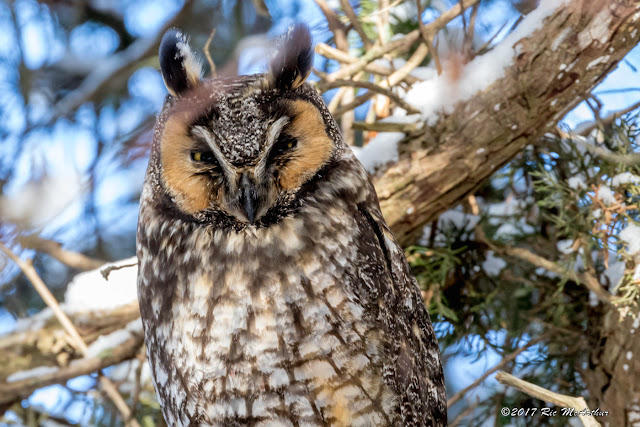
Long eared owl.

Image
 Thanks to some fellow birders and a very nice home owner we were able to see this long eared owl. The home owner was great, helping us see the birds in one of his cedar trees. He saw 9 in the tree in the morning but we "just" saw two. A real treat. Southern Ontario, Canada, February 25. 2025.. Asio otus The hoot of the male Long-eared Owl can sometimes be heard up to 1 kilometer (0.7 mi) away.

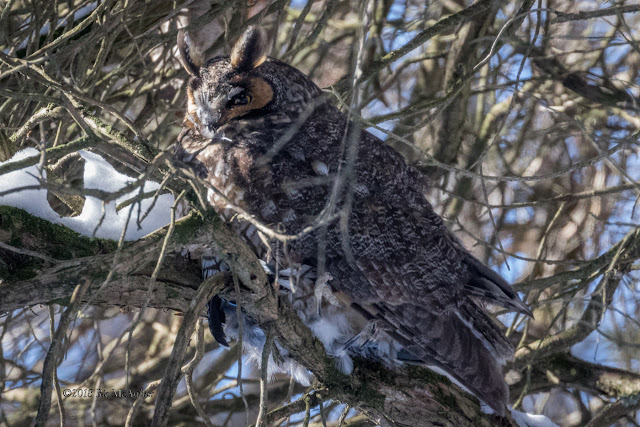
Long-eared owl.

Image
  A friend told us about 2 long eared owls that could be seen from the road. Tucked away behind all sorts of twigs and branches we were able to spot both. Images taken from the car with  telephoto lens to avoid disturbing the owls. Asio otus Like other owls, the Long-eared has a body adapted for silent flight and precision hunting. Flight feathers with fringed edges and downy surfaces mute the sound of the owl’s passage through air. The owls gain incredible hearing from their asymmetrically placed ear openings and large, sound-catching facial disks.

Brunch.

Image
Look closely and you will see a blue jay under the owl and a feather on the owls beak. Blue jays like to mob long eared owls, actually all owls, and perhaps this one paid the price. Asio otus Long-eared Owls are lanky owls that often seem to wear a surprised expression thanks to long ear tufts that typically point straight up like exclamation marks. These nocturnal hunters roost in dense foliage, where their camouflage makes them hard to find, and forage over grasslands for small mammals. Long-eared Owls are nimble flyers, with hearing so acute they can snatch prey in complete darkness. In spring and summer, listen for their low, breathy hoots and strange barking calls in the night. source -  https://www.allaboutbirds.org/guide/Long-eared_Owl/id
Image
Long eared owl, Rondeau Provincial Park, Dec 12, 2017. Thanks to local birders Steve and Aaron Charbonneau for the heads up about this owl. It moved trees when mobbed by blue jays but stayed in the immediate area. Asio otus The hoot of the male Long-eared Owl can sometimes be heard up to 1 kilometer (0.7 mi) away. source - https://www.allaboutbirds.org/guide/Long-eared_Owl/lifehistory