Posts

Showing posts with the label cape st mary's

Northern Gannet

Image
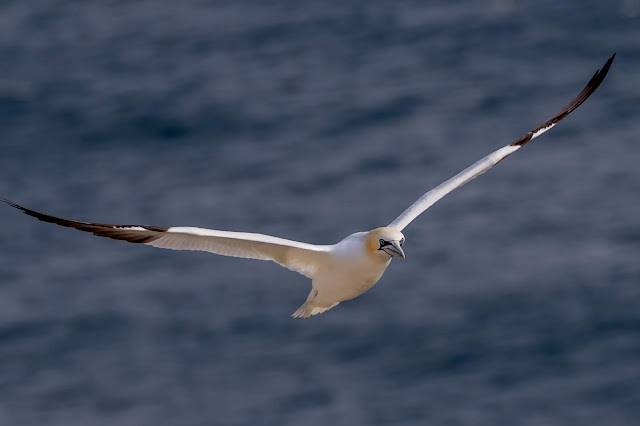
June 6, 2018, Cape St Mary's, Newfoundland. Amazing wingspan of up to 6 feet. Morus bassanus Their eyes have special structural adaptations for plunge-diving, and they are able to see well underwater immediately after striking the water. Most plunge-dives are relatively shallow, but the Northern Gannet can dive as deep as 72 feet. It uses its wings and feet to swim deeper in pursuit of fish.

Northern gannet

Image
Northern gannet, Cape st. Mary's Newfoundland, Canada. June 6, 2018 A beautiful day at the gannet colony with lots of birds flying. This one was coming in with a beakfull of nesting material. Gannets occupy the same nest year after year, until it becomes a substantial heap of feathers, fish skeletons, and droppings Morus bassanus The Northern Gannet is well equipped by nature for its spectacular plunges for fish from great heights. Unlike most birds, it has binocular vision—that is, its eyes are positioned such that it can see forward with both. This presumably gives it the ability to estimate how far the fish are from the surface of the water. Its strong, streamlined bill is 100 mm long. It has no nostril holes, and its upper and lower bills fit tightly together so that little if any water is forced into the mouth on impact with the surface. Its streamlined body has a system of air cells between the skin of its neck and shoulders and the muscle beneath....

Northern Gannet, Cape St Mary's, Newfoundland, Canada, June 6, 2018

Image
We went to the reserve at Cape St Mary's and were lucky to have a fog free day. Locals told us they have 200 fog days a year. This is one of hundreds of photos I took that day. Located about 200 km southwest of St. John's, Cape St. Mary's Ecological Reserve also known as "the Cape" is one of Newfoundland and Labrador's major seabird colonies. During the breeding season, it is home to 24,000 Northern gannet, 20,000 black-legged kittiwake, 20,000 common murre, and 2,000 thick-billed murre. In addition, more than 100 pairs of razorbill, more than 60 pairs of black guillemot, plus double-crested and great cormorant, and Northern fulmar nest there. source - http://www.flr.gov.nl.ca/natural_areas/wer/r_csme/ Morus bassanus Most plunge-dives are relatively shallow, but the Northern Gannet can dive as deep as 22 meters (72 feet). It uses its wings and feet to swim deeper in pursuit of fish. Northern Gannet, Cape St Mary's, Newfou...