Posts

Showing posts with the label animal

A surprise visitor.

Image
I saw an animal that I thought was a squirrel near our small pond but when I looked closely I realized it was a mink. We have had them in the yard before but not hunting in the pond. It dove into the pond which is not much bigger than the mink. It came out with a frog which it left on the grass. It went back several more times and caught more frogs. I went outside to get better photos and it seemed to scent me and started taking his prizes away. Neovison vison Minks are a voracious predator, and they eat a wide variety of prey and will store any surplus to eat later. source -arkive.org

Double your pleasure,double your fun..

Image
Twice the destructive force. Recently our little pond has been torn up each morning. I assumed that it was a raccoon but it turns out I was wrong. It was two raccoons. Double trouble. They are young ones that came out during the day. Taken through the Wonderful Wildlife Window. Procyon lotor  (almost sounds like a character from a Batman movie) These ubiquitous mammals are found in forests, marshes, prairies, and even in cities. They are adaptable and use their dexterous front paws and long fingers to find and feast on a wide variety of fare.

Ninja raccoon

Image
I think all racoons take ninja training. They can access high places without difficulty, squeeze through small spaces like ghosts and get into locked containers as if they had can openers. This one was raiding the suet then the grapes. When I went our to chase him off, he sneered at me and slowly sauntered away. Racoons really know how to saunter. Procyon lotor Raccoons in the northern parts of their range gorge themselves in spring and summer to store up body fat. They then spend much of the winter asleep in a den. There are six other species of raccoons, in addition to the familiar northern (North American) raccoon. Most other species live on tropical islands.

Explosion imminent.

Image
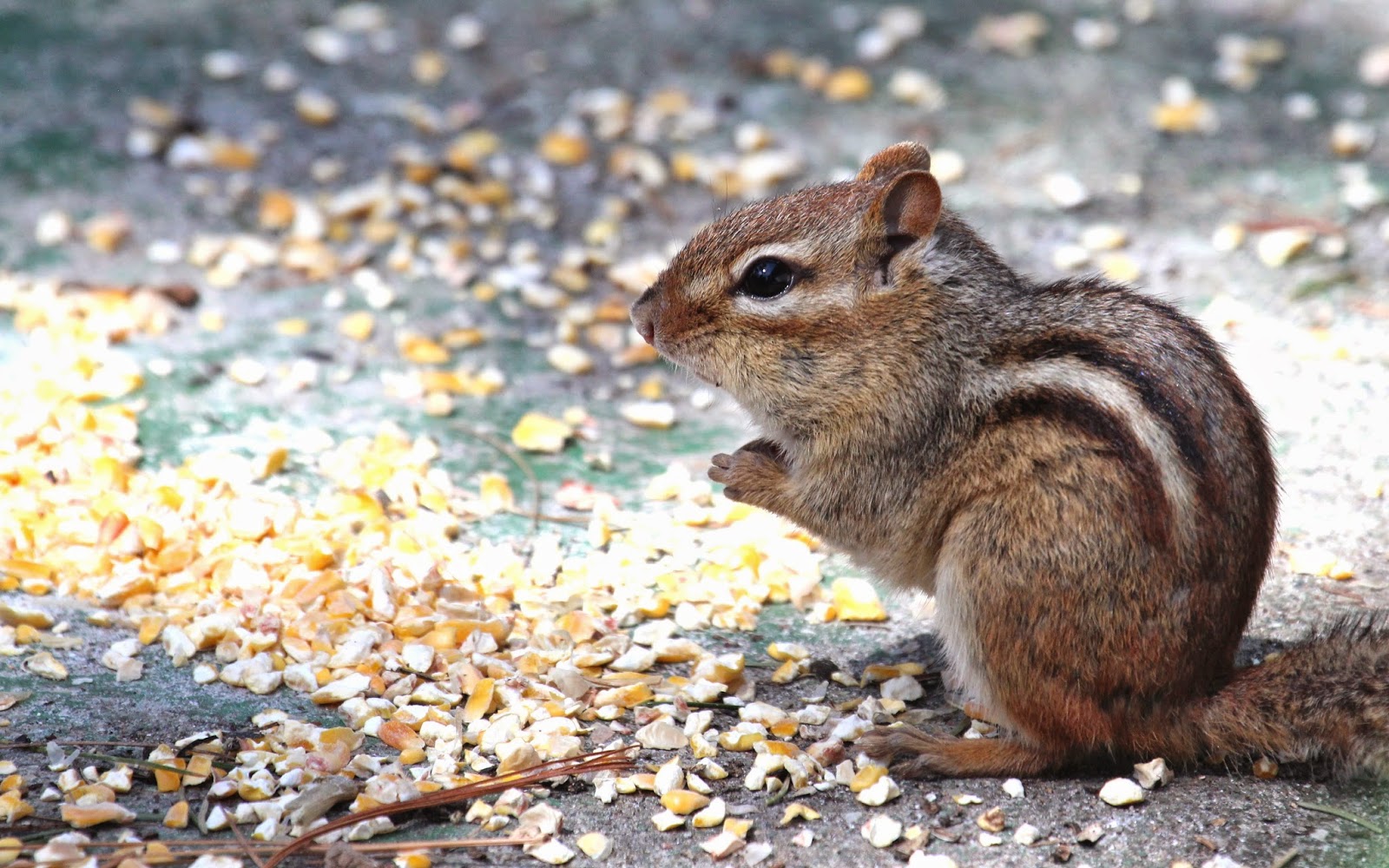
If he stuffs much more into those cheek pouches he gonna explode. This chipmunk was helping himself to the corn we put out for ground feeding birds. He was being greedy and was trying to eat the entire pile by himself. Tamius striatus During winter, chipmunks mostly stay in their burrows. They wake up every few days or weeks to snack from their stored food. That means they don't hibernate.

The ice runner

Image
The ice runner , a photo by ricmcarthur on Flickr. I was over at the far end of the park and spotted this coyote moving along the ice of the frozen channel leading out of Rondeau Bay. He seemed to be checking each of the small openings in the ice for injured waterfowl. He was about 200 yards from my position. Canis latrans The coyote Canis latrans is one of the seven representatives of the Canidae family found in Canada. Other members of the family are the wolf, red fox, arctic fox, grey fox, swift fox, and dog.  Slimmer and smaller than the wolf, the male coyote weighs from 9 to 23 kg, has an overall length of 120 to 150 cm (including a 30- to 40-cm tail), and stands 58 to 66 cm high at the shoulder. The female is usually four-fifths as large. 

Armoured division

Image
Armoured division , a photo by ricmcarthur on Flickr. his is a nine-banded armadillo that we saw in Texas. I thought you might appreciate a break from birds and/or winter.The one thing that tells everyone they are looking at an armadillo is the roly-poly shell with what are called "armoured" bands. The number of bands depends on the species. The pleated look of most armadillos is made of these hardened, overlapping sections. Although the bands are tough like fingernails, the shell is flexible, with softer skin that expands and contracts between the bands. Armadillos also have long claws for digging and foraging for food. Their peg-shaped teeth crunch through the bodies of insects, an armadillo's favourite food. Armadillo is Spanish for little armoured thing. Part of the armadillo's family name Dasypodidae, “dasypus,” is Greek for rabbit. The nine-banded armadillo has four identical pups in every litter.

Why did the muskrat cross the road?

Image
Why did the muskrat cross the road? , a photo by ricmcarthur on Flickr. Well, actually he didn't, he stopped half way. Not sure what he was doing our of his burrow, in the middle of winter in freezing temperatures but he was just sitting there on the road. I didn't try to move him as he didn't seem injured and it was a quiet back country road. I call it a he as a she would be smarter than to sit in the road. Muskrats are medium-sized semiaquatic rodent native to North America. It is basically a large field mouse that has adapted to life in and around water and has large hind feet that act like paddles during swimming. Ondatra zibethicus

Really? I thought squirrels were bad.

Image
Really? I thought squirrels were bad. , a photo by ricmcarthur on Flickr. You can buy feeders that are supposed to be squirrel proof and even a few that are racoon resistant but I don't think there are any commercial deer baffles. We looked out to see a white tailed deer eating out of the platform feeder. Shins on the baffle for balance and muzzle stuck into the feeder, the tongue flicking around like an anteater's. I know there are deer flies, I have been bitten by them often enough, but I'm not aware of a deer bird. The deer are welcome to clean up under the bird feeders but I think this is just being greedy. You can see a standard sized baffle on the feeder in the foreground, actually there are two baffles as our squirrels are creative. The baffle on the platform feeder is a custom made one that even keeps racoons at bay but evidently not deer. Odocoileus virginianus

I hear you knockin' But you can't come in

Image
I hear you knockin' But you can't come in , a photo by ricmcarthur on Flickr. Yes another deer photo, but as long as they keep coming this close I'm going to take the photos. This was taken through the wonderful wildlife window otherwise know as the living room window. The deer come in to clean up under the bird feeders, then they look in to see if we are going to put out more. She was about 2 feet from the window, the photo is not cropped. Odocoileus virginianus

The giraffe-deer of Rondeau

Image
The giraffe-deer of Rondeau , a photo by ricmcarthur on Flickr. Only seen in the winter, usually during snow storms when the drifts are deep, the giraffe-deer or Rondeau browse the lower edges of trees, juniper and cedars. Here you can see a doe showing its fawn how it is done. Standing on its rear legs it stretches to get any woody material. Odocoileus virginianus Serious over browsing can occur when population levels get too high for an area. The deer is a great jumper and runner. It can reach speeds of up to 58 kilometres per hour (35mph). Take through the Wonderful Wildlife Window.

Bambi in the bushes

Image
Bambi in the bushes , a photo by ricmcarthur on Flickr. While walking one of the trails in Rondeau Provincial Park, I flushed a white tailed deer. I continued walking and saw something on the path ahead of me. A fawn was on the path moving in the same direction the adult deer had gone. We looked at each other for about 5 seconds which was about 1 second more than the fawn felt comfortable with. It scurried off into the brush at the side of the trail and I was able to get a few photos. I don't know if the blue eye is a trick of the light as deer have brown eyes. Odocoileus virginianus

Hot enough for you?

Image
Hot enough for you? , a photo by ricmcarthur on Flickr. He had a drink of water then just flopped down as if it was too hot to do anything. Maybe he should have worn white. Summer is definitely back.