Posts

Showing posts with the label Numenius phaeopus

Whimbrel

Image
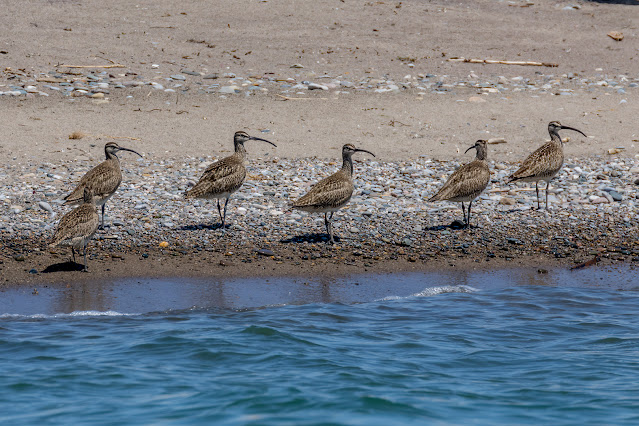
Rondeau Provincial Park, Ontario, Canada, May 25, 2022. Went out on the pontoon boat and had a good day with shore birds. Whimbrel were the most populus. Numenius phaeopus Numenius, the genus assigned to Whimbrel, means “new moon” in Greek, a reference to the bird’s bill shape, which resembles a crescent moon. source - Cornell Lab of Ornithology.

Whimbrel

Image
Rondeau Provincial Park, Ontario, Canada, May 27, 2021. We saw a flock of 28 on the south beach of the park from the pontoon boat. Numenius phaeopus Hope was the name given to a female Whimbrel captured on the coast of Virginia in 2009 and fitted with a satellite transmitter. Over the next three years, researchers tracked Hope for more than 50,000 miles (80,000 kilometers) traveling back and forth between her breeding area on the Mackenzie River in western Canada and her wintering site, at Great Pond on St. Croix, British Virgin Islands. Source -Cornell Lab of Ornithology- All About Birds

Whimbrel

Image
Rondeau Provincial Park, Ontario, Canada, May 20, 2021. While out on the pontoon boat we saw about 20 whimbrel along with black bellied plovers, ruddy turnstones, dunlin, least sandpipers, semi palmated plovers ab clack tern and a Caspian tern. A good day. Numenius phaeopus Numenius, the genus assigned to Whimbrel, means “new moon” in Greek, a reference to the bird’s bill shape, which resembles a crescent moon.

Whimbrel

Image
From a few years ago, whimbrel in flight at Rondeau Provincial Park. Numenius phaeopus Some migrating Whimbrels make a nonstop flight of 4,000 km (2,500 miles) from southern Canada or New England to South America. source -  https://www.allaboutbirds.org/guide/Whimbrel/

Whimbrel in flight.

Image
Each spring we get a few whimbrel passing through our area. We seem to manage to get the boat in just in time to check the south beach at Rondeau, across from Erieau. Numenius phaeopus Some migrating Whimbrels make a nonstop flight of 4,000 km (2,500 miles) from southern Canada or New England to South America. source - Cornell Lab of Ornithology.
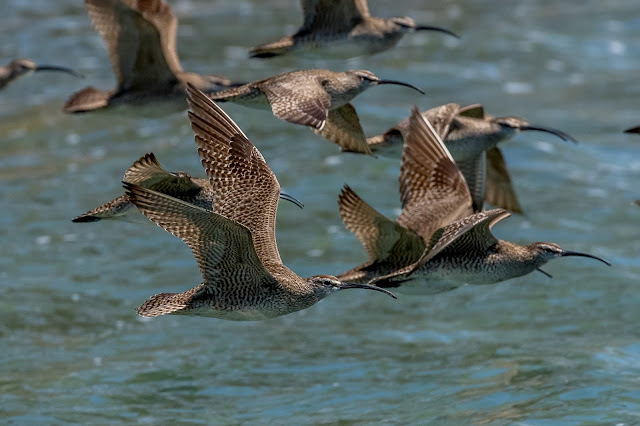
Whimbrel on the wing

Image
We finally got the pontoon boat in the water today and took a little cruise. We spotted about 120 whimbrel on Rondeau Provincial Parks south beach near Erieau, Ontario. It was  choppy making it difficult to get good photos. I think I'll try again tomorrow. Numenius phaeopus One of the most wide-ranging shorebirds in the world, the Whimbrel breeds in the Arctic in the eastern and western hemispheres, and migrates to South America, Africa, south Asia, and Australia. It uses its long, down-curved bill to probe deep in the sand of beaches for invertebrates, but also feeds on berries and insects. Some migrating Whimbrels make a nonstop flight of 4,000 km (2,500 miles) from southern Canada or New England to South America. source- Cornell Lab of Ornithology.

Whimbrel

Image
Whimbrel , a photo by ricmcarthur on Flickr. We were out on the boat yesterday and had a good day of birding. Kingfisher, sandhill cranes and this whimbrel were the highlights. We normally see whimbrel in the spring but this is the first we have seen in the summer. They probe the sand for marine invertebratesYou can see the grains of sand on its bill and the nostril hole that goes right through. Numenius phaeopus. Photo taken at Rondeau Provincial Park in southwestern Ontario.