Posts

Showing posts with the label rondeau bay

The fishing bird.

Image
They may attract fish by dipping their bill into water and vibrating it rapidly, creating a disturbance in the water that mimics motions made by prey fish, which this one was doing. Once they have caught prey, they shake their head rapidly, much like dog, until the prey is stunned or killed. Black crowned night heron, Rondeau Bay  Area, August 27, 2024, Ontario, Canada. Nycticorax nycticorax

Whooper swan

Image
Rondeau Bay, Ontario, Canada, Feb 19, 2023. This swan has been seen for a few days. Believed to be an escapee as it is so far out of range. Cygnus cygnus Immense swan of frigid northern regions; breeds on the tundra, taiga, and steppe and winters in marshy lakes and wetlands, often in wild areas. Fairly straight neck, short tail, and sloping bill distinct from Mute Swan; told from smaller Bewick’s (Tundra) Swan by larger and pointed yellow patch at base of bill, also lower-pitched and more bugling calls. Juvenile often dingier through first winter than juvenile Bewick’s; juveniles of both usually found with adults as family groups.

To ride the wind.

Image
To ride the wind. From the archives on another grey day. Certainly maintaining social distancing. Rondeau Bay, Rondeau Provincial Park, May 2, 2021.

Storms coming.

Image
Rondeau Bay, Rondeau Provincial Park, Nov 1, 2022.

Great egret,

Image
Rondeau Bay, Sept 29, 2022. Another of the birds we saw on the weed mats out in the bay. At times it would start sinking through the weed mat. Ardea alba. Great Egrets fly slowly but powerfully: with just two wingbeats per second their cruising speed is around 25 miles an hour.

Blanding's turtle

Image
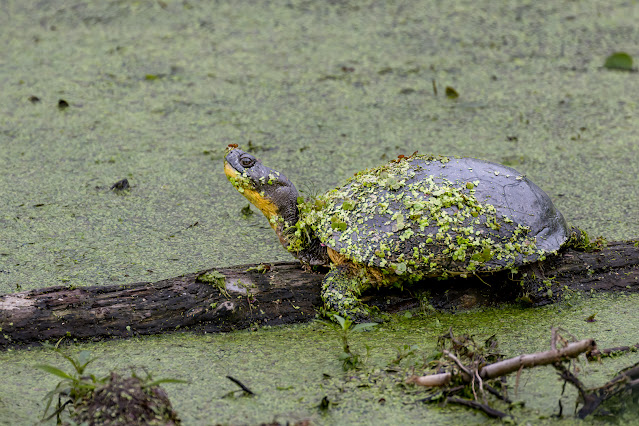
Rondeau Bay, June 7, 2022. Spotted quit a few turtles on a log on the way to see the pelican, this Blanding's was one of them. Emydoidea blandingii The Blanding’s Turtle is a medium-sized turtle easily identified by its bright yellow throat and chin. Unlike most Ontario turtles that have wide, flatter shells, the Blanding’s Turtle has a domed shell that resembles an army helmet. Its shell is black to brown with yellow flecks and streaks and can reach 27 centimetres long. Its head and limbs are black-grey and the bottom shell is rich yellow.

On the bay.

Image
Hen Hooded Merganser, Rondeau Bay, Rondeau Provincial Park, Nov 3, 2016 The drake hooded is spectacular but the hen is beautiful in her own right. Cool on the bay today, 60F, stiff breeze/wind and only partially sunny. Then again it is the 3rd of November and the boat should be out of the water. Lophodytes cucullatus Hooded Mergansers find their prey underwater by sight. They can actually change the refractive properties of their eyes to improve their underwater vision. In addition, they have an extra eyelid, called a “nictitating membrane,” which is transparent and helps protect the eye during swimming, like a pair of goggles.

Now stretch...

Image
This mallard was going through a bathing routine, dunking under the eater and preening its feathers. Then it stretched its head way back. Interesting to watch. Anas platyrhynchos Ducks are strong fliers; migrating flocks of Mallards have been estimated traveling at 55 miles per hour. The standard duck’s quack is the sound of a female Mallard. Males don’t quack; they make a quieter, rasping sound.

Will that be one foot or two?

Image
Hard to tell if he has one tucked up or if he only has one talon. We saw 8 bald eagles out on the ice a long way off and this one perched close in a tree. Another person who got there earlier than us saw 16 eagles on Rondeau Bay. At Erieau, Ontario. The science stuff Haliaeetus leucocephalus Immature Bald Eagles spend the first four years of their lives in nomadic exploration of vast territories and can fly hundreds of miles per day. Some young birds from Florida have wandered north as far as Michigan, and birds from California have reached Alaska. source Cornell Lab of Ornithology.

In your face.

Image
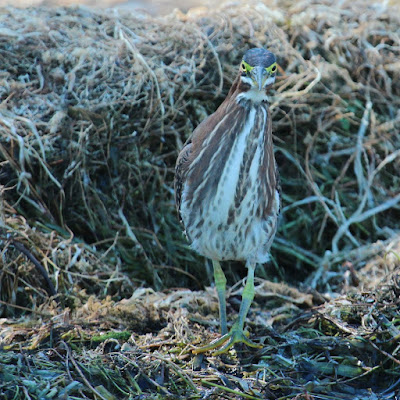
We saw this Green Heron while out on the boat back in September. Butorides virescens The Green Heron is one of the world’s few tool-using bird species. It creates fishing lures with bread crusts, insects, earthworms, twigs, feathers, and other objects, dropping them on the surface of the water to entice small fish.

Bookends.

Image
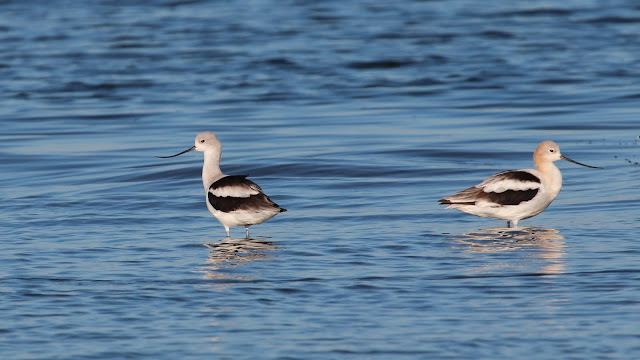
While out birding on the boat we came across a pair of American Avocets on a sandbar in the bay. A rare visitor to our area. Also picked up a rusty blackbird, flying soras,egrets, great blues and a calling virginia rail. Recurvirostra americana American Avocet chicks leave the nest within 24 hours after hatching. Day-old avocets can walk, swim, and even dive to escape predators. source 0 Cornell Lab of Ornithology.

Looks like he's doing a John Cleese routine.

Image
This great blue heron was bending, stretching,wing flaring his wings as he stood on a log. Didn't seem to notice us in our boat getting closer and closer. We finally left it to finish his routine. Ardea herodias Thanks to specially shaped neck vertebrae, Great Blue Herons can curl their neck into an S shape for a more aerodynamic flight profile and to quickly strike prey at a distance.

Rondeau Bay.

Image
I went flying today and learned two things. Don't do aerial photography during hot humid weather - you get haze, and use a polarizing filter which I didn't have. Overall I was satisfied and I had a blast. This is Rondeau Bay with Erieau, Ontario in the foreground. We dock our pontoon boat there. To the right is Rondeau Provincial Park where we have a cottage. In the distance is Lake Erie, one of the Great Lakes in North America. This is looking to the north-east. More photos later. I ran off over a 1,000 shots. Thank goodness for digital.

Way down the bay.

Image
Rondeau Bay finally has open areas, just in time to provided a resting place for migrating tundra swans. Most of the swans seem to have moved elsewhere but there were about 1,000 in the bay. They were approx. 1.5 miles from where I took this photo. The tree line in the distance is the end of the bay and just past them is Lake Erie. Cygnus columbianus Order: Anseriformes Family: Anatidae During the breeding season the Tundra Swan sleeps almost entirely on land, but in the winter it sleeps more often on water. source - Cornell Lab of Ornithology.

Flash Freeze

Image
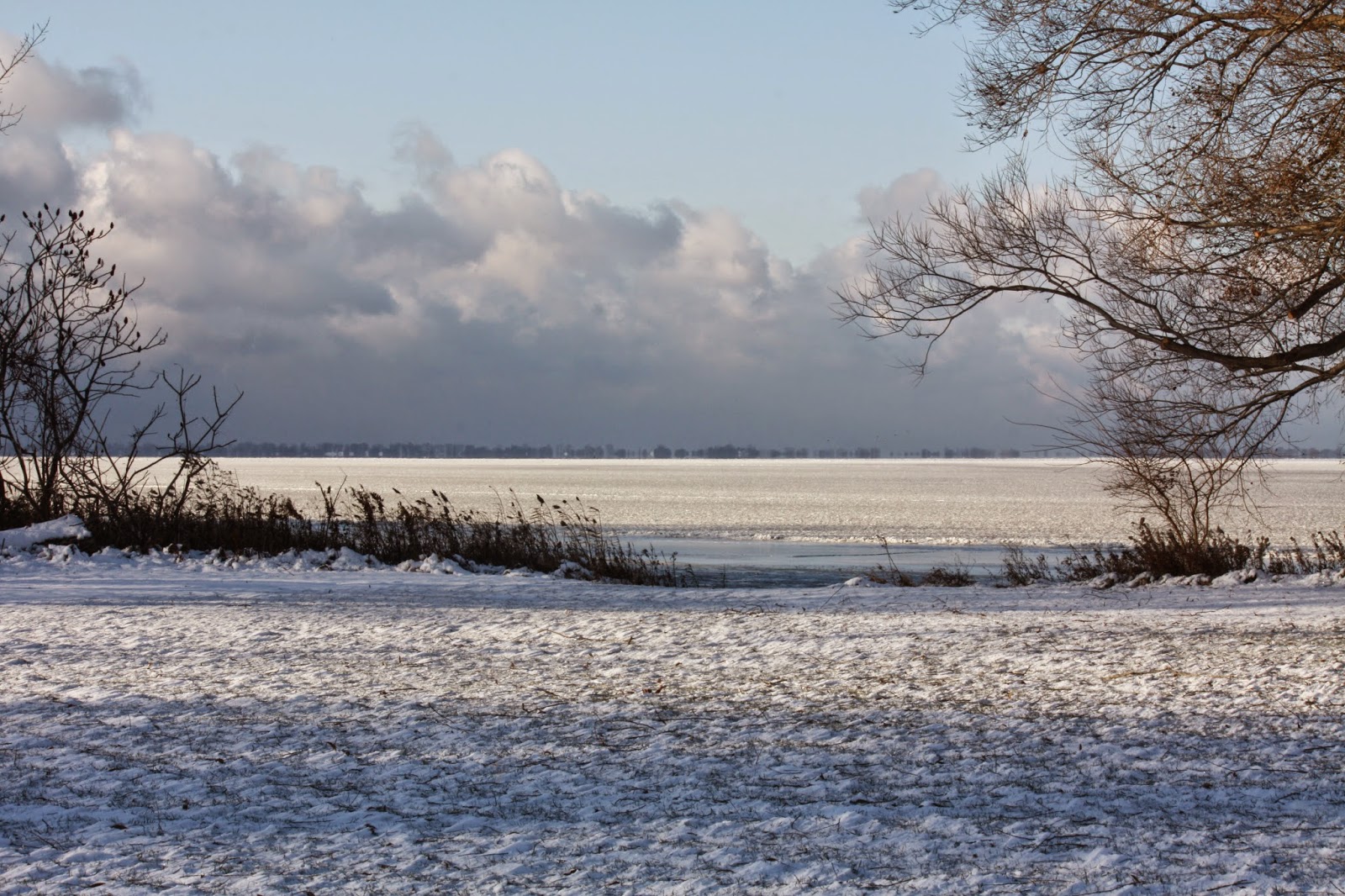
Yesterday this was open water, it froze overnight. The far shore is about 6km, 3 + miles, away. The clouds represent more snow coming in. At least we are better off than Buffalo N.Y. at the other end of Lake Erie. They have received over 4 feet , well over a meter,of snow in two days and are expecting another two feet. Temperatures are far below freezing and it is only November. Bah! Humbug! Remember to fill those bird feeders.

Leaning

Image
I spooked this great blue heron while out on the pontoon this afternoon. The flight shots didn't turn out but this one of the takeoff made me think of someone leaning a little too far forward. Ardea herodias Great Blue Herons can hunt day and night thanks to a high percentage of rod-type photoreceptors in their eyes that improve their night vision. The oldest Great Blue Heron, based on banding recovery, was 24 years old.

Stranded.

Image
 400 feet from shore is the last section of the Rondeau pier that is still intact. Heavy ice this year knocked pilings sideways and buckled the decking to the point it was unsafe. At this time the government hasn't decided what action to take as repairs would cost approximately $700,000. Just the pilings. Due to severe ice damage the decking of the pier had to be removed. The edge should be a straight line but the ice moved the pilings Wiggles like a snake.

We've had some drifting snow here.

Image
We've had some drifting snow here. , a photo by ricmcarthur on Flickr. This is a winter that just won't quit. Brutal cold, snow and high winds are resulting in hardship for people and animals. Yesterday the wind whipped up massive snow drifts around houses located beside Rondeau Bay. Drifts were over a storey high at some locations. Cars are buried and snow removal companies are having difficulty keeping up. I would go to Florida but they are cold as well, just no snow, yet. Stay warm and safe.

Do you want that super sized?

Image
Do you want that super sized? , a photo by ricmcarthur on Flickr. If you haven't had the opportunity to watch a heron or egret eat a large fish it is like watching a teenager gobble down a super sized fast food hamburger, fries and drink in 60 seconds. You can't quite believe your eyes. How does the bird juggle the fish without loosing it and then swallow it whole? This was taken on Rondeau Bay last summer. Right now the heron has been supplanted by ice fisherpeople. I just get my ice from the freezer, it's much easier. Ardea herodias Thanks to specially shaped neck vertebrae, Great Blue Herons can curl their neck into an S shape for a more aerodynamic flight profile and to quickly strike prey at a distance. The oldest Great Blue Heron, based on banding recovery, was 24 years old.

The carrot bill

Image
The carrot bill , a photo by ricmcarthur on Flickr. The Caspian tern is one of the easier birds to id, with its large, thick, and brilliant coral red bill. Hydroprogne caspia The Caspian Tern is the largest tern in the world. Young Caspian Terns appear to have a difficult time learning to catch fish efficiently. They stay with their parents for long periods of time, and are fed by them even on the wintering grounds. Many young terns do not return to the nesting grounds for several years, remaining instead on the wintering areas. The oldest known wild Caspian Tern lived to be more than 26 years old. Average life span of Great Lakes Caspian Terns is estimated to be 12 years.