Posts

Showing posts with the label great horned owl

In a tree far, far, away.

Image
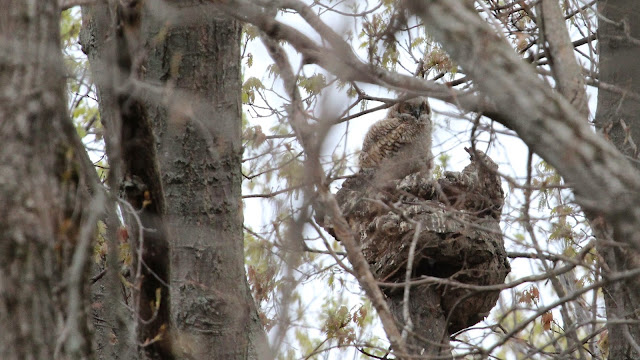
 Great horned owl chicks in the bottom of a cracked limb .  Heavily cropped, telephoto lens to avoid disturbing the birds. We didn't see an adult in the immediate area, Bubo virginianus When clenched, a Great Horned Owl’s strong talons require a force of 28 pounds to open. The owls use this deadly grip to sever the spine of large prey.
Great horned owl

Image
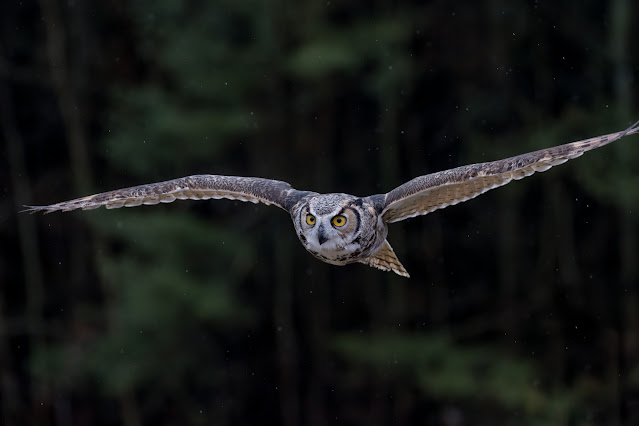
Great horned owl at the Canadian Raptor Conservancy March 25, 2017. This is a captive bred owl. Bubo virginianus If you hear an agitated group of cawing American Crows, they may be mobbing a Great Horned Owl. Crows may gather from near and far and harass the owl for hours. The crows have good reason, because the Great Horned Owl is their most dangerous predator. source -allaboutbirds-org

Great horned owl

Image
Chatham, Ontario,Mar 30, 2021. Bubo virginianus When clenched, a Great Horned Owl’s strong talons require a force of 28 pounds to open. The owls use this deadly grip to sever the spine of large prey. Source -Cornell Lab of Ornithology- All About Birds

The Guardian.

Image
The adult great horned owl was sitting high in a nearby tree watching over the chick I posted yesterday. Chatham, Ontario, April 24, 2019. Bubo virginianus The oldest Great Horned Owl on record was at least 28 years old when it was found in Ohio in 2005. source - https://www.allaboutbirds.org/guide/Great_Horned_Owl/

Owlet.

Image
Great horned owl, Chatham, Ontario, April 24, 2019. There are two but one was hidden. Bubo virginianus When clenched, a Great Horned Owl’s strong talons require a force of 28 pounds to open. The owls use this deadly grip to sever the spine of large prey. source - https://www.allaboutbirds.org/guide/Great_Horned_Owl/

Great horned owl in the rain.

Image
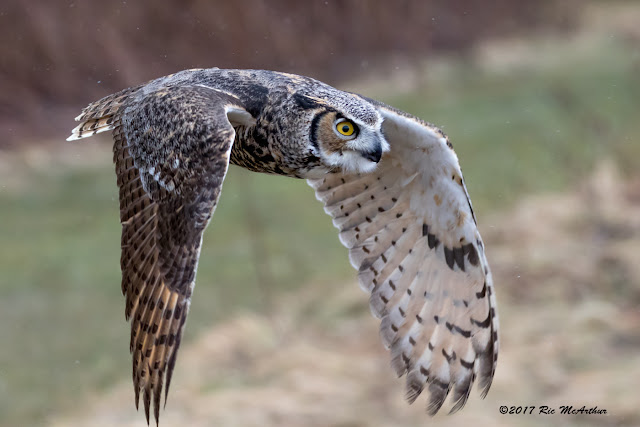
Taken at the  Canadian Raptor Conservancy facility on  a rainy day. Bubo virginianus Great Horned Owls are fierce predators that can take large prey, including raptors such as Ospreys, Peregrine Falcons, Prairie Falcons, and other owls. They also eat much smaller items such as rodents, frogs, and scorpions. source -https://www.allaboutbirds.org/guide/Great_Horned_Owl/lifehistory

Season of the Owl

Image
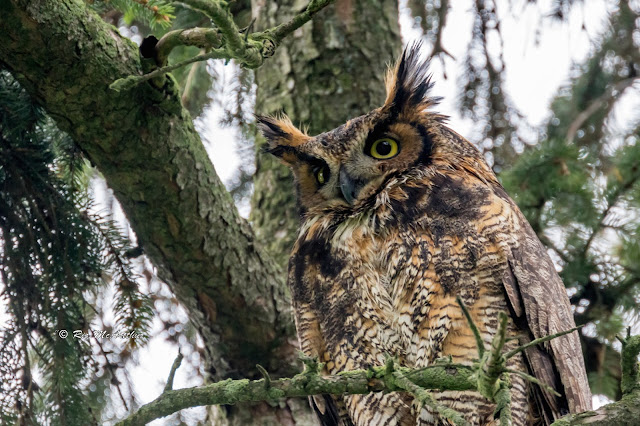
Another Great Horned Owl shot. This one shows why it is called a horned owl. Bubo virginianus Great Horned Owls are fierce predators that can take large prey, including raptors such as Ospreys, Peregrine Falcons, Prairie Falcons, and other owls. They also eat much smaller items such as rodents, frogs, and scorpions.
Image
Great horned owl, adult. This is one of the adults watching over the chick I posted yesterday. Probably 90 feet up in the tree.

Great horned owl.

Image
Great Horned Owl chick, London Ontario, April 17, 2017 A well known owl near downtown London. The chicks fledged yesterday and we just saw the one plus an adult. Bubo virginianus Great Horned Owls have large eyes, pupils that open widely in the dark, and retinas containing many rod cells for excellent night vision. Their eyes don’t move in their sockets, but they can swivel their heads more than 180 degrees to look in any direction. They also have sensitive hearing, thanks in part to facial disc feathers that direct sound waves to their ears.

Great horned owl

Image
Another photo from the photo shoot at the Canadian Raptor Conservancy. In the rain.

Great horned owl

Image
Went with a group of photographers to the Canadian Raptor Conservancy for a raptor photo shoot. One of the birds was a great horned owl. The weather was miserable, raining and cold, the light was less than desireable, but the birds were great. The spots are rain drops. Bubo virginianus Even though the female Great Horned Owl is larger than her mate, the male has a larger voice box and a deeper voice. Pairs often call together, with audible differences in pitch.

The season of the owl.

Image
It seems everyone is posting great horned owls this time of year So I decided I would put up my photo, just to be social. The location of this bird was published in the local paper but the exact location of the nest was not. Bubo virginianus Great Horned Owls are fierce predators that can take large prey, including raptors such as Ospreys, Peregrine Falcons, Prairie Falcons, and other owls. They also eat much smaller items such as rodents, frogs, and scorpions.

Screw off, eh.

Image
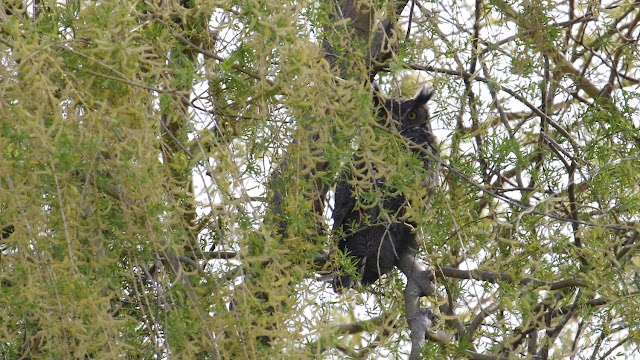
Not happy to see us. This owl nest is well hidden in a willow tree. We approached by boat. We didn't stay long as we were getting the evil eye. Bubo virginianus When clenched, a Great Horned Owl’s strong talons require a force of 28 pounds to open. The owls use this deadly grip to sever the spine of large prey. source - Cornell Lab of Ornithology.
Upstanding.

Image
This great horned owl chick is in still in the nest. It's sibling left yesterday and is somewhere else in the tree. The nest appears to be a broken branch in the shape of a bowl. Bubo virginianus When clenched, a Great Horned Owl’s strong talons require a force of 28 pounds to open. The owls use this deadly grip to sever the spine of large prey. The oldest Great Horned Owl on record was at least 28 years old when it was found in Ohio in 2005. source - Cornell Lab of Ornithology.
Great horned owl chicks

Image
Great horned owl chicks , a photo by ricmcarthur on Flickr. In a small, and I do mean small, woodlot on the north side of Chatham, a pair of great horned owls have successfully reared a pair of chicks. The nest is about 12 feet up in a broken tree. The parents were keeping watch in the tall trees nearby. Very poor light and rain. Hope to go back on the weekend when they are forecasting better weather. We are hoping no one harasses the chicks and they get to fledge. bubo vriginianus