Posts

Showing posts with the label american redstart

Bad hair day.

Image
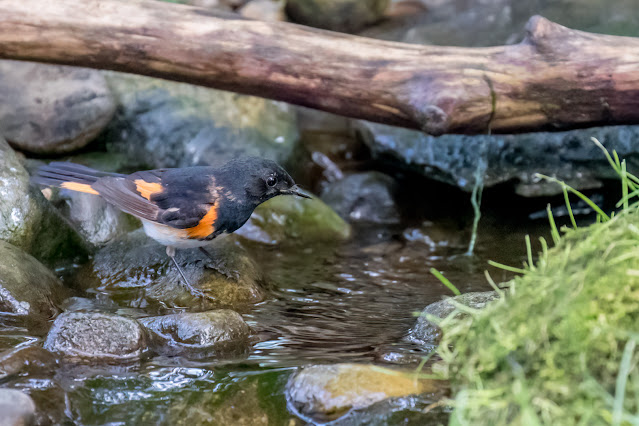
You thought you were having a bad hair day?  American redstart in the water feature in our yard. Rondeau Provincial Park, Ontario, Canada, June 15, 2025. Setophaga ruticilla  The oldest American Redstart was at least 10 years and one month old, when he was recaptured and rereleased during a banding operation in Ontario.

American redstart

Image
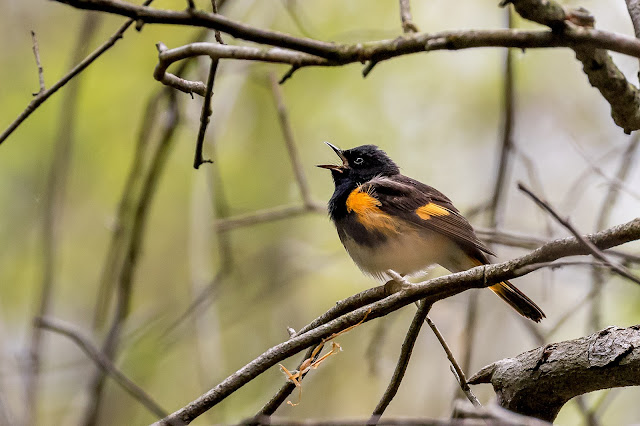
  Not sure if this was a breeding display for the female that was in the yard or an aggression display to keep other birds out of his bath. Either way it is a beautiful bird. Rondeau Provincial Park, Ontario, Canada, June 4, 2025. Setophaga ruticilla The male American Redstart sometimes has two mates at the same time. While many other polygamous bird species involve two females nesting in the same territory, the redstart holds two separate territories that can be separated by a quarter-mile. The male begins attracting a second female after the first has completed her clutch and is incubating the eggs.

American redstart

Image
Rondeau provincial Park, July 4, 2023. An unexpected visitor to the water feature this evening. Occasionally we see a female but this is the first breeding plumage male since migration. Setophaga ruticilla The oldest American Redstart was at least 10 years and one month old, when he was recaptured and rereleased during a banding operation in Ontario.
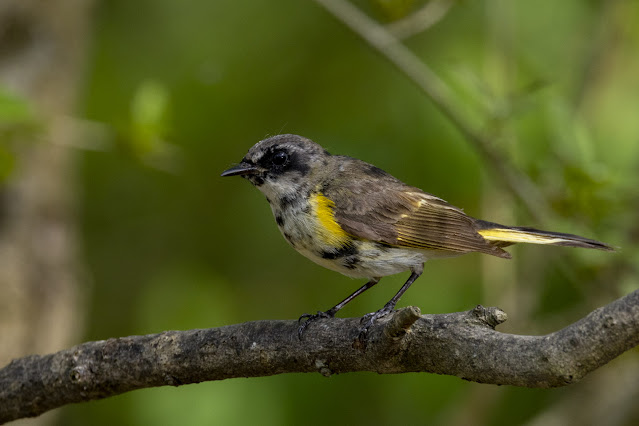
Not ready for prime time.

Image
American redstart, Rondeau Provincial Park, June 2, 2023. Looks like a young male growing into breeding plumage. Setophaga  ruticilla Young male American Redstarts have gray-and-yellow plumage, like females, until their second fall. Yearling males sing vigorously in the attempt to hold territories and attract mates. Some succeed, but most do not breed successfully until the following year when they develop black-and-orange breeding plumage.

American redstart

Image
American redstart, near Rondeau, May 17, 2023. I was told they want to be a Baltimore Oriole when they grow up. Setophaga ruticilla. Young male American Redstarts have gray-and-yellow plumage, like females, until their second fall. Yearling males sing vigorously in the attempt to hold territories and attract mates. Some succeed, but most do not breed successfully until the following year when they develop black-and-orange breeding plumage. source -allaboutbirds-org.

American redstart

Image
In the stream, Rondeau Provincial Park, May 22, 2022. Snowing and cold, need a splash of colour. Setophaga ruticilla The American Redstart is a unique warbler. The male is black with orange patches on each wing, on the sides of its breast, and at the base of its tail on either side. The male's throat is black, but its breast and belly are white. The female is gray where the male is black, and yellow where the male is orange. The female also has a white eye-ring. Juveniles and first-year males look like females, although first-year males generally have some black on the upper breast or head. The American Redstart has a relatively short, wide bill.

A surprise visit.

Image
American redstart, Rondeau Provincial Park, June 30, 2022. For most of June we have yellow warblers but no others. This redstart popped in late in the day and was a welcome surprise. Setophaga  ruticilla. American Redstarts are common spring and fall migrants in the East. It is a later spring migrant (arriving in May in much of the U.S. and Canada) and a mid-season fall migrant (September-early October). source - Cornell Lab of Ornithology.

American redstart

Image
May 22, 2019, Rondeau Provincial Park, Ontario, Canada. Techincally spring is 3 weeks away but we won't be seeing the warblers for at least 5 weeks. Setophaga ruticilla The male American Redstart sometimes has two mates at the same time. While many other polygamous bird species involve two females nesting in the same territory, the redstart holds two separate territories that can be separated by a quarter-mile. The male begins attracting a second female after the first has completed her clutch and is incubating the eggs . Source - Cornell Lab of Ornithology.

American redstart

Image
Rondeau Provincial Park, Ontario, Canada, Sept 26, 2021. Migration has slowed, this is from Sept. Setophaga ruticilla Like the Painted Redstart and other “redstarts” of the Neotropics, the American Redstart flashes the bright patches in its tail and wings. This seems to startle insect prey and give the birds an opportunity to catch them.

American redstart

Image
Sept 7, 2018, Rondeau Provincial Park, Ontario, Canada. Trying to see what the crazy neighbours are doing. Setophaga ruticilla Like the Painted Redstart and other “redstarts” of the Neotropics, the American Redstart flashes the bright patches in its tail and wings. This seems to startle insect prey and give the birds an opportunity to catch them. Though these birds share a common name, they are not closely related to each other. In fact, there are other unrelated birds around the world—such as the fantails of Australia and southeastern Asia, and other redstarts of Europe—that share the same foraging tricks. source - https://www.allaboutbirds.org/guide/American_Redstart

Warbler migration.

Image
American Redstart, Rondeau Provincial Park, Ontario, Canada, May 22, 2019. One of the many warbler species that pass through Rondeau during migration. Setophaga ruticilla American Redstarts flash the bright patches in its tail and wings. This seems to startle insect prey and give the birds an opportunity to catch them. source -  https://www.allaboutbirds.org/guide/American_Redstart/
Image
Coming soon to a forest near you. American Redstart, Rondeau Provincial Park, Ontario, Canada, May 20, 2017. Tired of winter, looking forward to the migration. Setophaga ruticilla Like the Painted Redstart and other “redstarts” of the Neotropics, the American Redstart flashes the bright patches in its tail and wings. This seems to startle insect prey and give the birds an opportunity to catch them. Though these birds share a common name, they are not closely related to each other. source -  https://www.allaboutbirds.org/guide/American_Redstart/

American redstart.

Image
One of the many warblers passing through Rondeau this migration. The American Redstart singing his heart out. Setophaga ruticilla Like the Painted Redstart and other “redstarts” of the Neotropics, the American Redstart flashes the bright patches in its tail and wings. This seems to startle insect prey and give the birds an opportunity to catch them. Though these birds share a common name, they are not closely related to each other. source - Cornell Lab of Ornithology.

I like redstarts.

Image
The tail flaring makes them easy to identify. They move quickly and it can be difficult getting a photo. Setophaga ruticilla Like the Painted Redstart and other “redstarts” of the Neotropics, the American Redstart flashes the bright patches in its tail and wings. This seems to startle insect prey and give the birds an opportunity to catch them. Though these birds share a common name, they are not closely related to each other. In fact, there are other unrelated birds around the world—such as the fantails of Australia and southeastern Asia, and other redstarts of Europe—that share the same foraging tricks. source - Cornell Lab of Ornithology.

American Redstart

Image
American Redstart , a photo by ricmcarthur on Flickr. This is a shot from one of our trips to Texas, where we went to get away from winter. It turned out to be two of the mildest winters we have had in recent memory. Staid home this year, bad idea. Anyway, the redstart is a fast moving warbler that bounces around in search of insects. I find them difficult to photograph, mostly blurred or behind a branch, this one messed up and sat still in the open. Setophaga ruticilla Like the Painted Redstart and other “redstarts” of the Neotropics, the American Redstart flashes the bright patches in its tail and wings. The male American Redstart sometimes has two mates at the same time. While many other polygamous bird species involve two females nesting in the same territory, the redstart holds two separate territories that can be separated by a quarter-mile. The male begins attracting a second female after the first has completed her clutch and is incubating the eggs.

A splash of colour

Image
A splash of colour , a photo by ricmcarthur on Flickr. The American Redstart is about 5 1/4 inches long and is a fast mover, actively flitting, with drooping winds and spread tail. Basically a black bird with bright orange patches on its wings and tail. This is one of the spring warblers we get in the yard during spring migration. They look like the want to be a baltimore oriole when they grow up. Setophaga ruticilla