Posts

Showing posts with the label eastern towhee

Eastern towhee

Image
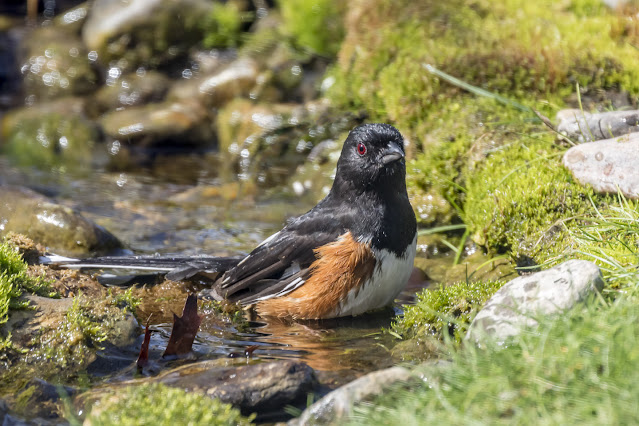
 More often heard than seen this visitor to the eater feature is always a treat to see. Rondeau Provincial Park, Ontario, Canada, July 10, 2025 .Pipilo erythrophthalmus A strikingly marked, oversized sparrow of the East, feathered in bold black and warm reddish-browns – if you can get a clear look at it. Eastern Towhees are birds of the undergrowth, where their rummaging makes far more noise than you would expect for their size. Their  chewink  calls let you know how common they are, but many of your sightings end up mere glimpses through tangles of little stems.

Eastern towhee.

Image
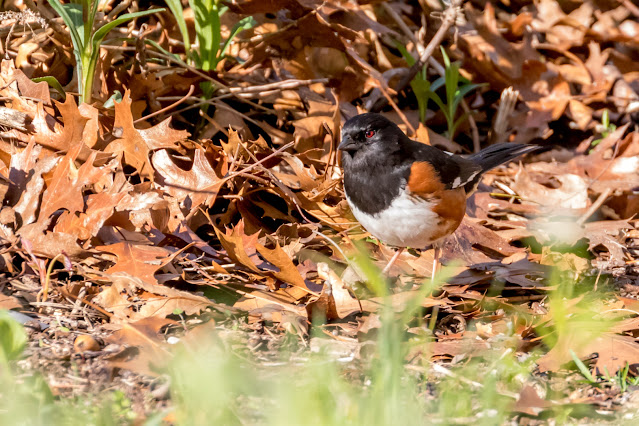
  First of year, March 16, 2025, Rondeau Provincial Park, Ontario, Canada. Taken through the wonderful wildlife window. Say the first on the 15th finally got a shot the next day. Also had a northern flicker but didn't get an image. Pipilo erythrophthalmus Eastern Towhees tend to be pretty solitary, and they use a number of threat displays to tell other towhees they’re not welcome. You may see contentious males lift, spread, or droop one or both wings, fan their tails, or flick their tails to show off the white spots at the corners. Studies have shown that male towhees tend to defend territories many times larger than needed simply to provide food.

Eastern towhee

Image
Eastern towhee, Rondeau Provincial Park, April 5, 2023. A first of year visit by a towhee. Image taken through the Wonderful Wildlife Window. Pipilo erythrophthalmus Eastern Towhees tend to be pretty solitary, and they use a number of threat displays to tell other towhees they’re not welcome. You may see contentious males lift, spread, or droop one or both wings, fan their tails, or flick their tails to show off the white spots at the corners. Studies have shown that male towhees tend to defend territories many times larger than needed simply to provide food.

A splash of colour.

Image
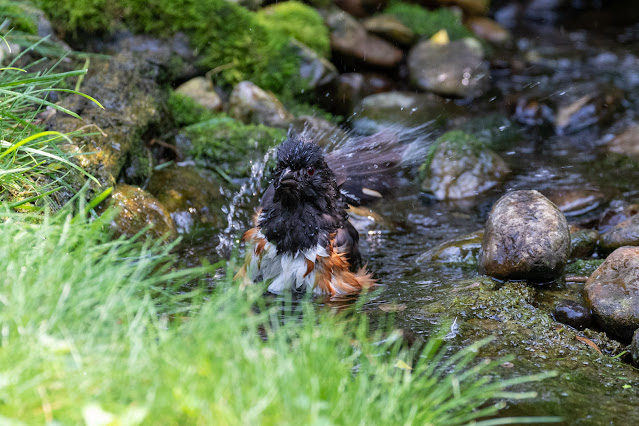
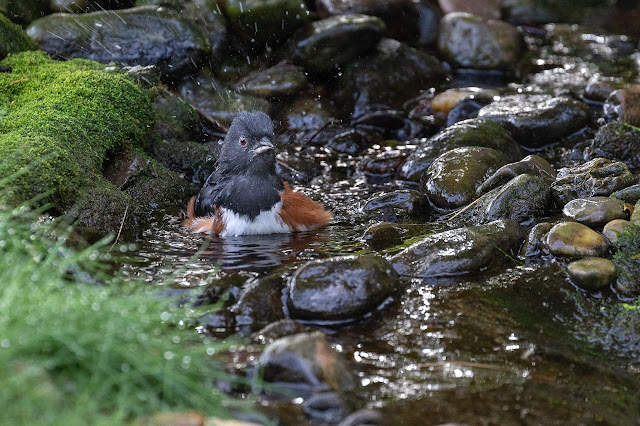
Eastern towhee, Rondeau Provincial Park, having a bath, Apr 17, 2021. Pipilo erythrophthalmus Eastern Towhees tend to be pretty solitary, and they use a number of threat displays to tell other towhees they’re not welcome. You may see contentious males lift, spread, or droop one or both wings, fan their tails, or flick their tails to show off the white spots at the corners. Studies have shown that male towhees tend to defend territories many times larger than needed simply to provide food.

Spish splash, I was taking a bath...

Image
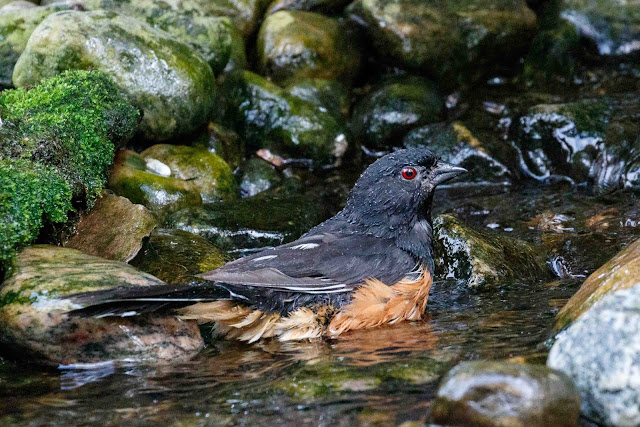
Eastern towhee bathing enthusiastically in our little water feature. Rondeau Provincial Park, Ontario, Canada, June 10, 2022. Pipilo erythrophthalmus Eastern Towhees are common victims of the parasitic Brown-headed Cowbird. Female cowbirds lay eggs in towhee nests, then leave the birds to raise their cowbird young. In some areas cowbirds lay eggs in more than half of all towhee nests. Towhees, unlike some other birds, show no ability to recognize or remove the imposter’s eggs. Female cowbirds typically take out a towhee egg when laying their own, making the swap still harder to notice. source - Cornell Lab of Ornithology.

Waiting for the blizzard.

Image
Had the rain, freezing rain, snow just starting, temperatures heading for the basement. The storm had just started when this Eastern Towhee showed up in the yard next to a puddle. Very unusual/rare at this time of year. Rondeau Provincial Park, Ontario, Canada, Feb 17, 2022. Taken throught the Wonderful Wildlife Window. Pipilo erythrophthalmus Eastern Towhees tend to be pretty solitary, and they use a number of threat displays to tell other towhees they’re not welcome. You may see contentious males lift, spread, or droop one or both wings, fan their tails, or flick their tails to show off the white spots at the corners. Studies have shown that male towhees tend to defend territories many times larger than needed simply to provide food. source- Cornell Lab of Ornithology.

Eastern towhee

Image
Eastern towhee, May 6, 2021, Rondeau Provincial Park, Ontario, Canada. Usually skulking in the undergrowth, this male came out into the sunshine. Pipilo erythrophthalmus Eastern Towhees tend to be pretty solitary, and they use a number of threat displays to tell other towhees they’re not welcome. You may see contentious males lift, spread, or droop one or both wings, fan their tails, or flick their tails to show off the white spots at the corners. Studies have shown that male towhees tend to defend territories many times larger than needed simply to provide food. source- Cornell Lab of Ornithology.

A twitch to the tail and it's done.

Image
Eastern Towhee having an enthusiatic bath at our little water feature. Rondeau Provincial Park, Ontario, Canada, August 1, 2021. Pipilo erythrophthalmus Eastern Towhees tend to be pretty solitary, and they use a number of threat displays to tell other towhees they’re not welcome. You may see contentious males lift, spread, or droop one or both wings, fan their tails, or flick their tails to show off the white spots at the corners. Studies have shown that male towhees tend to defend territories many times larger than needed simply to provide food. Source -Cornell Lab of Ornithology- All About Birds

Eastern Towhee

Image
Rondeau Provincial Park, Ontario, Canada, March 21, 2021. This male towhee showed up in our yard Sunday, routing through the underbrush and tossing leaves. Pipilo erythrophthalmus Eastern Towhees are common victims of the parasitic Brown-headed Cowbird. Female cowbirds lay eggs in towhee nests, then leave the birds to raise their cowbird young. In some areas cowbirds lay eggs in more than half of all towhee nests. Towhees, unlike some other birds, show no ability to recognize or remove the imposter’s eggs. Female cowbirds typically take out a towhee egg when laying their own, making the swap still harder to notice. Source -Cornell Lab of Ornithology- All About Birds

Eastern Towhee

Image
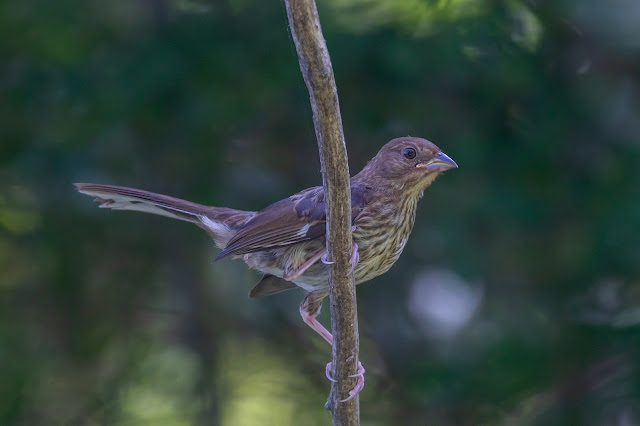
Rondeau Provincial Park, Ontario, Canada, Aug 21, 2020. Immature towhee hanging around the pond in the yard. Pipilo erythrophthalmus Eastern Towhees are likely to visit – or perhaps live in – your yard if you’ve got brushy, shrubby, or overgrown borders. If your feeders are near a vegetated edge, towhees may venture out to eat fallen seed. source - https://www.allaboutbirds.org/guide/Eastern_Towhee/

Eastern towhee, July 5, 2020.

Image
At the pond, Rondeau Provincial Park, Ontario, Canada. Pipilo erythrophthalmus The oldest known Eastern Towhee was a male in South Carolina, and at least 12 years, 3 months old.

Eastern Towhee at the pond.

Image
Rondeau Provincial Park, Ontario, Canada, June 30, 2020. Pipilo erythrophthalmus Eastern Towhees tend to be pretty solitary, and they use a number of threat displays to tell other towhees they’re not welcome. You may see contentious males lift, spread, or droop one or both wings, fan their tails, or flick their tails to show off the white spots at the corners. Studies have shown that male towhees tend to defend territories many times larger than needed simply to provide food. source - https://www.allaboutbirds.org/guide/Eastern_Towhee

Eastern towhee.

Image
Eastern Towhee, Rondeau Provincial Park, Ontario, Canada, Nov 5, 2019. A female or immature eastern towhee in the pond earlier this month. Pipilo erythrophthalmus Eastern Towhees tend to be pretty solitary, and they use a number of threat displays to tell other towhees they’re not welcome. You may see contentious males lift, spread, or droop one or both wings, fan their tails, or flick their tails to show off the white spots at the corners. Studies have shown that male towhees tend to defend territories many times larger than needed simply to provide food.

Eastern towhee

Image
Rondeau Provincial Park, Ontario, Canada, Sept 29, 2019. I hear this species much more often than I see one. Pipilo erythrophthalmus Eastern Towhees tend to be pretty solitary, and they use a number of threat displays to tell other towhees they’re not welcome. You may see contentious males lift, spread, or droop one or both wings, fan their tails, or flick their tails to show off the white spots at the corners. Studies have shown that male towhees tend to defend territories many times larger than needed simply to provide food.

Towhee

Image
Eastern Towhee, Rondeau Provincial Park, April 26, 2019. I've been hearing towhees for weeks and had a few glimpses but today we had two in the yard and they weren't playing nicely. Pipilo erythrophthalmus Eastern Towhees tend to be pretty solitary, and they use a number of threat displays to tell other towhees they’re not welcome. You may see contentious males lift, spread, or droop one or both wings, fan their tails, or flick their tails to show off the white spots at the corners. Studies have shown that male towhees tend to defend territories many times larger than needed simply to provide food. source - https://www.allaboutbirds.org/guide/Eastern_Towhee/

My alarm clock.

Image
Eastern Towhee, Rondeau Provincial Park, Ontario, Canada, July 31, 2018 Another pond visitor that we hear much more frequently than we see them. Recently they have been calling at 5.30 a.m., before I've had my COFFEE!!! Pipilo erythrophthalmus Eastern Towhees tend to be pretty solitary, and they use a number of threat displays to tell other towhees they’re not welcome. You may see contentious males lift, spread, or droop one or both wings, fan their tails, or flick their tails to show off the white spots at the corners. Studies have shown that male towhees tend to defend territories many times larger than needed simply to provide food. source - https://www.allaboutbirds.org/guide/Eastern_Towhee/

A winter towhee.

Image
A winter towhee. , a photo by ricmcarthur on Flickr. We don't normally have towhees in our area during winter but this one is wintering at the visitor centre at Rondeau Provincial Park. They are a summer bird that breeds in southern Ontario and migrate to warmer areas in the winter. Towhees eat many foods: seeds, fruits, insects, spiders, millipedes, centipedes, and snails, as well as soft leaf and flower buds in spring. They also eat seeds and fruits, including ragweeds, smartweeds, grasses, acorns, blackberries, blueberries, wheat, corn, and oats. Source- The Cornell Lab of Ornithology. Pipilo erythrophthalmus The oldest known Eastern Towhee was 12 years, 3 months old.