Posts

Showing posts with the label wilson's snipe

Wilson's snipe

Image
From the archieves Wilson's snipe, Rondeau Provincial Park, Oct 6, 2016. Seen from the pontoon boat near the south end of the marsh. Gallinago delicata Wilson’s Snipe look so stocky thanks in part to the extra-large pectoral (breast) muscles that make up nearly a quarter of the bird’s weight—the highest percent of all shorebirds. Thanks to their massive flight muscles this chunky sandpiper can reach speeds estimated at 60 miles an hour. source - https://www.allaboutbirds.org/guide/Wilsons_Snipe

Wilson's Snipe,

Image
Rondeau Provincial Park, Ontario, canada, Sept 10, 2021. Seen whole out on the pontoon boat, first of the year. Gallinago delicata Wilson’s Snipe look so stocky thanks in part to the extra-large pectoral (breast) muscles that make up nearly a quarter of the bird’s weight—the highest percent of all shorebirds. Thanks to their massive flight muscles this chunky sandpiper can reach speeds estimated at 60 miles an hour. source- Cornell Lab of Ornithology.

Wilson's snipe

Image
Feb 16, 2021, Stefina Line, Blenheim, Ontario, Canada. Went out for a drive after the snow storm to check for birds. Didn't get the Virginia rail or snowy owl but did get two northern harriers, four rough legged hawks and two snipe, only one in the photo. Much closer than the last time. Gallinago delicata Wilson’s Snipe feed by burying their bills deep into soft, wet soil to probe for insect larvae, worms, and other invertebrate prey. The bill’s flexible tip can open to grasp food while the base of the bill stays closed. Snipe can slurp small prey from the mud without having to remove their bill from the soil. source - https://www.allaboutbirds.org/guide/Wilsons_Snipe

Wilson's Snipe,

Image
Near Blenheim, Ontario, Canada, Feb 11, 2021. Two snipe in a drainage ditch, uncommon this time of year. We have had snipe at this location, over the winter, for several years now. Gallinago delicata Wilson’s Snipe look so stocky thanks in part to the extra-large pectoral (breast) muscles that make up nearly a quarter of the bird’s weight—the highest percent of all shorebirds. Thanks to their massive flight muscles this chunky sandpiper can reach speeds estimated at 60 miles an hour. source - https://www.allaboutbirds.org/guide/Wilsons_Snipe

Wilson's snipe.

Image
Near Blenheim, Ontario, Canada, Feb 2, 2019. Not something you expect to see in southern Ontario in February. Somehow it managed to survive the polar vortex which packed stunning wind chills. And, yes, that is snow and ice around it. Gallinago delicata Wilson’s Snipe look so stocky thanks in part to the extra-large pectoral (breast) muscles that make up nearly a quarter of the bird’s weight—the highest percent of all shorebirds. Thanks to their massive flight muscles this chunky sandpiper can reach speeds estimated at 60 miles an hour. source -  https://www.allaboutbirds.org/guide/Wilsons_Snipe

Wilson's Snipe

Image
Anne worked her magic again today and found this snipe tucked into the shoreline. Last cruise of the year. Boat comes out on Tuesday. Gallinago delicata The word “sniper” originated in the 1770s among British soldiers in India who hunted snipe as game. The birds are still hunted in many countries, including the U.S., though their fast, erratic flight style means they are difficult targets.

Why snipe are hard to find.

Image
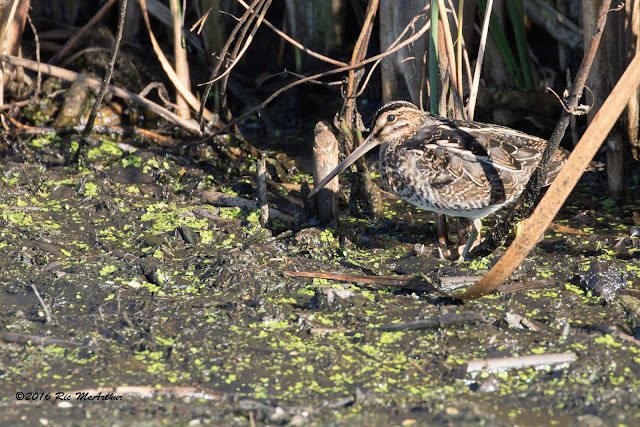
They are masters of camouflage. ©2016 Ric McArthur Gallinago delicata Wilson’s Snipe look so stocky thanks in part to the extra-large pectoral (breast) muscles that make up nearly a quarter of the bird’s weight—the highest percent of all shorebirds. Thanks to their massive flight muscles this chunky sandpiper can reach speeds estimated at 60 miles an hour.

At the edge of the marsh

Image
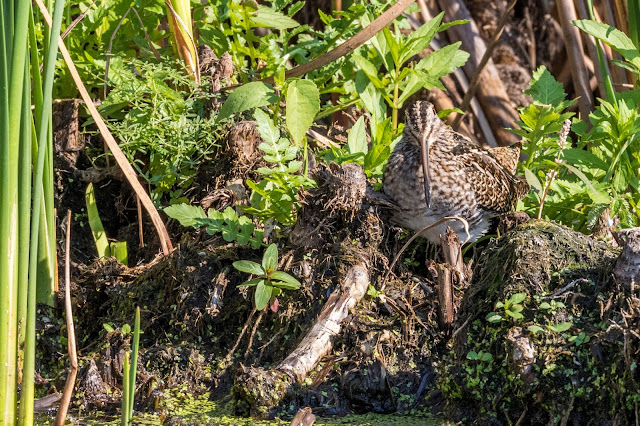
A wilson's snipe seen from the pontoon, very well camouflaged. We see lots of sora most trips but few snipes. Gallinago delicata Though the long tradition of “snipe hunt” pranks at summer camp has convinced many people otherwise, Wilson’s Snipes aren’t made-up creatures. These plump, long-billed birds are among the most widespread shorebirds in North America. They can be tough to see thanks to their cryptic brown and buff coloration and secretive nature