Posts

Showing posts with the label Haemorhous mexicanus

Feeding Behaviour.

Image
House finches.  April 8, 2025, Rondeau Provincial Park, Ontario, Canada. In the hedge in the yard a pair of house finches displaying courting behaviour with the male giving seeds to the female. Haemorhous mexicanus The red of a male House Finch comes from pigments contained in its food during molt (birds can’t make bright red or yellow colors directly). So the more pigment in the food, the redder the male. This is why people sometimes see orange or yellowish male House Finches. Females prefer to mate with the reddest male they can find, perhaps raising the chances they get a capable mate who can do his part in feeding the nestlings. House Finches feed their nestlings exclusively plant foods, a fairly rare occurrence in the bird world. Many birds that are vegetarians as adults still find animal foods to keep their fast-growing young supplied with protein.
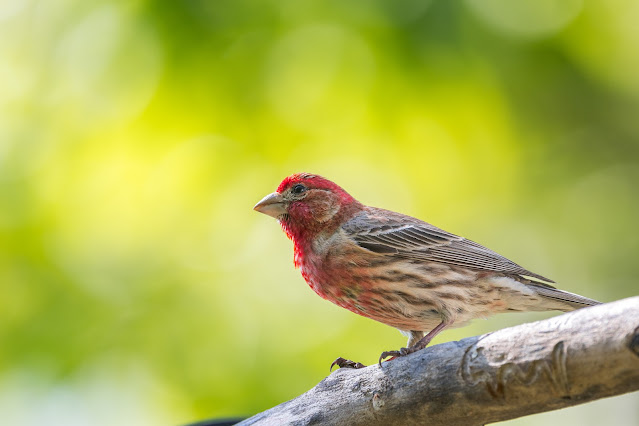
House finch.

Image
 House finch, Rondeau Provincial Park, Ontario, Canada, May 30, 2023, waiting its turn at the water. Haemorhous mexicanus. The red of a male House Finch comes from pigments contained in its food during molt (birds can’t make bright red or yellow colors directly). So the more pigment in the food, the redder the male. This is why people sometimes see orange or yellowish male House Finches. Females prefer to mate with the reddest male they can find, perhaps raising the chances they get a capable mate who can do his part in feeding the nestlings.

House finch

Image
House finch, Rondeau Provincial Park, April 14, 2023. A welcome splash of colour at the water feature. Haemorhous mexicanus. House Finches feed their nestlings exclusively plant foods, a fairly rare occurrence in the bird world. Many birds that are vegetarians as adults still find animal foods to keep their fast-growing young supplied with protein. source - allaboutbirds-org

House finch

Image
House finch, March 15, 2023, Rondeau Provincial Park. Haemorhous mexicanus The red of a male House Finch comes from pigments contained in its food during molt (birds can’t make bright red or yellow colors directly). So the more pigment in the food, the redder the male. This is why people sometimes see orange or yellowish male House Finches. Females prefer to mate with the reddest male they can find, perhaps raising the chances they get a capable mate who can do his part in feeding the nestlings. source - allaboutbirds-org.

House Finch.

Image
House Finch. A recent visitor to our little water feature. Rondeau Provincial Park, April 24, 2022. Haemorhous mexicanus House Finches feed their nestlings exclusively plant foods, a fairly rare occurrence in the bird world. Many birds that are vegetarians as adults still find animal foods to keep their fast-growing young supplied with protein. source - Cornell Lab of Ornithology.
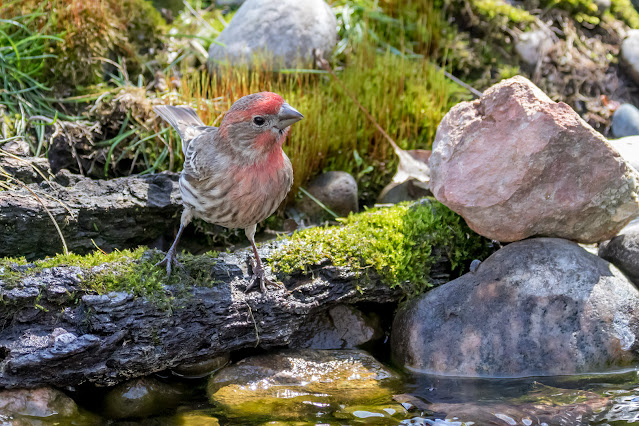
House finch.

Image
House finch, Rondeau Provincial Park, Ontario, Canada, Nov 23, 2021 A vistor to the water feature. Haemorhous mexicanus The red of a male House Finch comes from pigments contained in its food during molt (birds can’t make bright red or yellow colors directly). So the more pigment in the food, the redder the male. This is why people sometimes see orange or yellowish male House Finches. Females prefer to mate with the reddest male they can find, perhaps raising the chances they get a capable mate who can do his part in feeding the nestlings. source- Cornell Lab of Ornithology.

House finch

Image
House finch, Sept 26, 2021, Rondeau Provincial Park, Ontario, Canada. Haemorhous mexicanus The House Finch was originally a bird of the western United States and Mexico. In 1940 a small number of finches were turned loose on Long Island, New York, after failed attempts to sell them as cage birds (“Hollywood finches”). They quickly started breeding and spread across almost all of the eastern United States and southern Canada within the next 50 years. source- Cornell Lab of Ornithology.

House finch

Image
Rondeau Provincial Park, Ontario, Canada, March 31, 2021. Nice to see, haven't been many around. Haemorhous mexicanus The red of a male House Finch comes from pigments contained in its food during molt (birds can’t make bright red or yellow colors directly). So the more pigment in the food, the redder the male. This is why people sometimes see orange or yellowish male House Finches. Females prefer to mate with the reddest male they can find, perhaps raising the chances they get a capable mate who can do his part in feeding the nestlings. Source -Cornell Lab of Ornithology- All About Birds

House finch

Image
House finch, Rondeau Provincial Park, April, 6, 2019, Ontario, Canada. A pond visitor this afternoon. Haemorhous mexicanus The total House Finch population across North America is staggering. Scientists estimate between 267 million and 1.4 billion individuals. source - https://www.allaboutbirds.org/guide/House_Finch/

A pair of house finches,

Image
We have had both purple finches and house finches in the yard for a few weeks. It is more common for us to see the  house finch. Haemorhous mexicanus The red of a male House Finch comes from pigments contained in its food during molt (birds can’t make bright red or yellow colors directly). So the more pigment in the food, the redder the male. This is why people sometimes see orange or yellowish male House Finches. Females prefer to mate with the reddest male they can find, perhaps raising the chances they get a capable mate who can do his part in feeding the nestlings.

House finch

Image
One of the regular birds at our feeders. The total House Finch population across North America is staggering. Scientists estimate between 267 million and 1.4 billion individuals. Haemorhous mexicanus The oldest known House Finch was 11 years, 7 months old.
Image
This is a male house that is starting to show his spring colour. Usually there are several birds in the basket but he was peckish and drove everyone else away. Haemorhous mexicanus The House Finch was originally a bird of the western United States and Mexico. In 1940 a small number of finches were turned loose on Long Island, New York, after failed attempts to sell them as cage birds (“Hollywood finches”). They quickly started breeding and spread across almost all of the eastern United States and southern Canada within the next 50 years. The oldest known House Finch was 11 years, 7 months old.